
Read the blend instructions
A key may list one symbol beside two floss numbers, sometimes with a ratio such as one strand of each. Read the complete instruction. Two numbers could also be alternatives rather than a blend, depending on the chart.
For a one-plus-one blend, separate one strand of color A and one of color B. Align the two working strands and thread them together, leaving a short loose tail beyond the eye. You now have two working strands in total.
If you fold both strands in half and bring all four ends together, you have made a four-strand combination. That may overfill the holes and change the coverage. Our folded-loop guide explains why that start doubles working strands; a stitched-over tail is a practical alternative for a one-plus-one blend.
Keep the pair together through both diagonals
Make the first diagonal with A and B side by side, then the second diagonal with the same pair. Both colors are present in each leg. Let twist relax when needed and avoid pulling one strand so tightly that the other loops on the surface.
Scarlet Quince's coverage examples show photographed blends across several fabrics and strand counts. They also demonstrate that using one color on the lower diagonal and a different color on the upper diagonal can produce a different result from carrying both together. The upper leg may dominate.
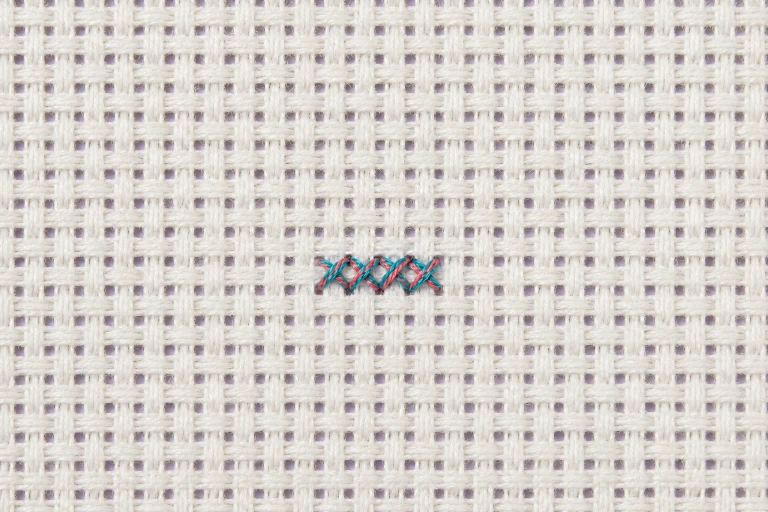
Both colors in each leg
Keep one strand of each color together through both diagonals.
View original photo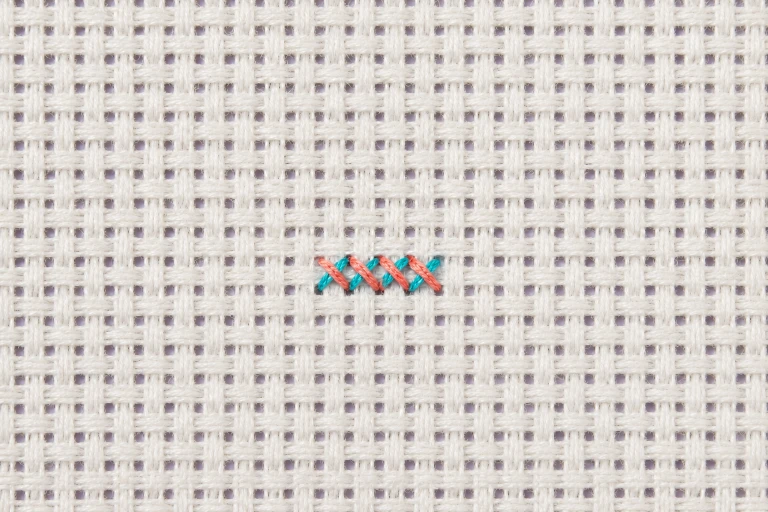
One color in each leg
Stitching the two diagonals in separate colors gives a different result from blending both strands.
View original photoLabel blends with the symbol and floss codes
Keep spare blended lengths with their chart symbol, floss codes, and strand counts. Several blends may share one color, so the pair needs its own identification.
For example, a card for a two-color blend could read “symbol B: one strand of DMC 550 + one strand of DMC 351; total two.” In your project, copy the floss numbers and strand counts from the key.
Changing the strand count
Keep the proportions in the key. For a one-plus-one blend, a three-strand version cannot use equal amounts of both colors. A four-strand version could use two of each, but may be too bulky for the fabric. Try a small area before changing the pattern's recommendation.
If the stitches feel unexpectedly thick, check whether folding doubled the strands. Pulling harder won't improve coverage and can distort the cloth.
If the strands separate or twist
Pause when one color starts making small loops while the other lies taut. Trace both back toward the needle. A strand may have caught at the eye or been pulled unevenly during threading.
Ease out the most recent leg if necessary and realign the pair. Use a clean cut end and a needle eye that fits the strands comfortably. Separate the strands from each skein individually before recombining them; pulling a group out together can leave extra twist.
With metallic, silk, variegated, or other specialty threads, follow the specified blend and thread-maker guidance.
Estimate each color separately
For example, put a 40 cm strand of A together with a 40 cm strand of B. You have a 40 cm working length with two strands, before allowing for tails and anchoring. You have used 40 cm of each color.
That doesn't directly tell you how many full crosses you can make. Stitch size, route, tails, and restarts affect the requirement. Use the pattern's quantities or include those allowances when you estimate the skeins to buy.