
Choose one way to describe the move
These two instructions describe the same gap: “leave four squares empty” and “move five squares right.” The first counts only blank cells. The second counts changes in cell position from one stitched cell to the other.
Use chart coordinates when they are available. If the chart doesn't number every column, use its bold 10-square lines as a reference and number a small working section on a separate copy. Keep the chart oriented the same way as the fabric.
A chart's empty-looking square may have a specific meaning, so check its legend first. Some designs leave the fabric bare; others use a faint symbol for a pale thread. Stitched Modern's chart-reading guide explains why the grid and key belong together.


Work through one horizontal gap
Imagine a cross in column 2, row 2. Your next intended cross is in column 7 of the same row.
- Keep the first cross as the reference. Don't call it the first blank square.
- Count columns 3, 4, 5, and 6 as the four empty cells.
- Place the next cross in column 7, after those empty cells.
- Check the return count from column 7 to column 2. The change in column number is five.
When translating this to fabric, choose the same corner of each cross as the position marker, such as the lower-left hole. Moving from the lower-left corner of column 2's cell to the lower-left corner of column 7's cell crosses five fabric-square intervals.
Don't count the starting hole as interval one. Count the spaces you move across. If you count aloud, say each number as you move to the next hole.
Add a vertical change separately
Suppose the next cross belongs at column 7, row 5 instead. From column 2, row 2, move five columns right and three rows down. Count the horizontal and vertical directions independently.
Use a corner or color block near the destination as a second check. If the chart says the destination is two rows below a verified leaf, compare that distance on the fabric before putting the needle through.
Check long gaps in smaller sections
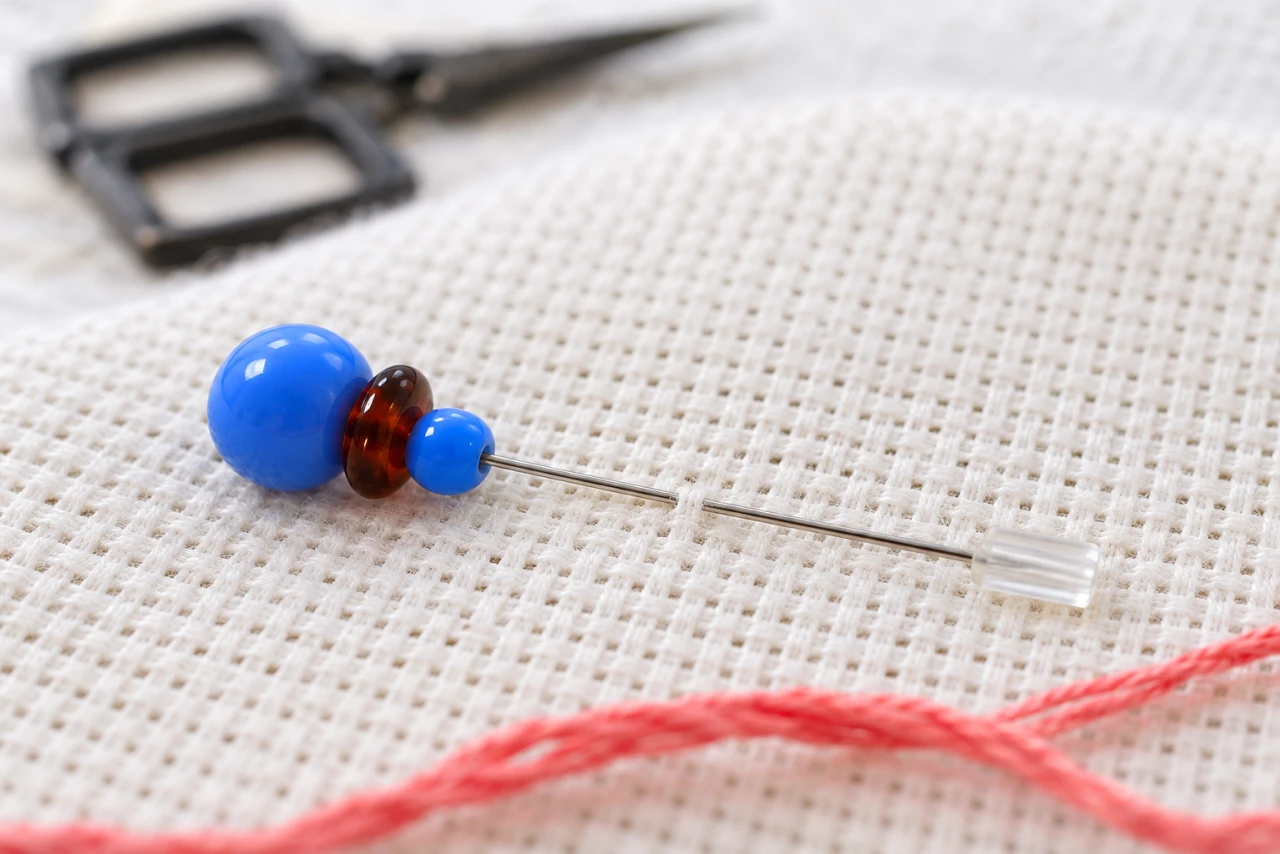
Use a removable thread marker or counting pin appropriate for the cloth to hold a location while you recount. Put the marker away securely afterward. Don't push an ordinary pencil line into the fabric and assume washing will remove it.
For a long chart move, count full 10-cell blocks and then the remainder. A move of 23 columns is two blocks of ten plus three. Start those blocks from a known grid line or verified stitch, not from a convenient but uncertain edge.
If a fabric grid is already present, compare its position with the chart's grid. The center of the design doesn't always lie at a 10-by-10 grid intersection. Copying a grid from the center without checking that offset can move every marked line.
Decide whether to carry the thread
Once you have counted the gap, decide whether to carry the thread across the back or restart it. A long dark thread behind unstitched pale fabric can show through; a tight carry can pull separate motifs toward each other. You may want to end the thread and start again near the new cross.