
Count the strands before cutting
The conventional folded-loop start doubles the strands you begin with. One folded strand gives two working strands; two folded strands give four. The fold becomes the loop that anchors your first stitch.
That makes this method convenient when the chart calls for an even number of strands of ordinary stranded cotton. For a single working strand, three strands, or a blend that needs one strand each of two different colors, choose a different start. Use a stitched-over tail or another suitable start for those combinations. On an over-two linen or evenweave grid, a pin-stitch start is another option; its route uses the openings inside that larger stitch footprint.
Variegated thread adds another consideration: folding can place different parts of its color transition alongside each other. If your pattern or thread maker specifies how to align the color changes, follow that instruction. Our variegated-floss guide explains the choice.
Make the fold
Take one strand about twice your comfortable stitching length. For example, an 80 cm strand folded in half produces two 40 cm lengths, before allowing for the needle tail and starting loop.
Line up the two cut ends. Thread them together through the needle and leave a small loose tail at the eye. The other end remains a closed fold. Do not thread the folded loop through the needle and leave the cut ends at the far end; that arrangement removes the starting loop we need.
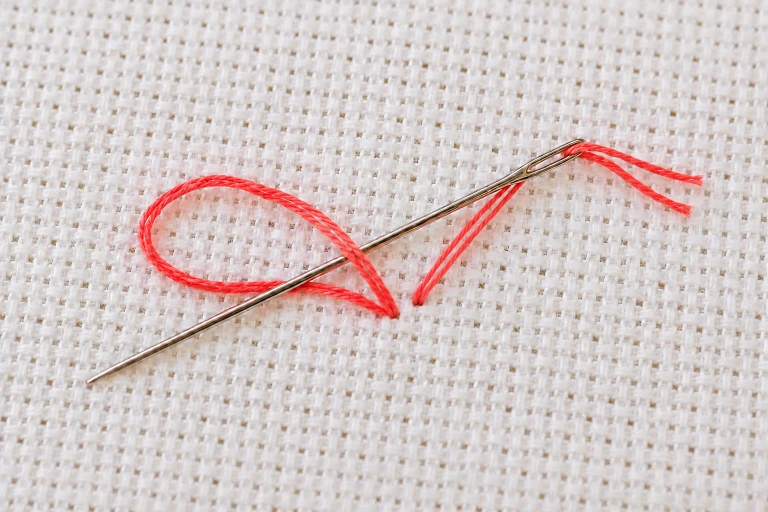
Catch the folded loop
Pass the needle through the folded loop on the back before drawing it snug.
Enlarge photo
Follow one square
We'll name the corners of one Aida square: A is bottom left, B is top right, C is bottom right, and D is top left. This example makes / as the lower leg and \ as the top leg. You can use the opposite convention consistently throughout your project.
- Bring the needle from the back to the face at A. Leave enough of the folded loop visible on the back to pass a needle through comfortably.
- Take the needle down at B. You have made the first diagonal, A to B, on the face.
- Turn the work over. Pass the needle through the folded loop without going through the fabric again.
- Draw the thread gently until the loop closes around the thread on the back. Stop when it sits flat. Pulling harder can distort the first stitch.
- Return to the face. Come up at C and go down at D to complete the cross.
Stitched Modern's loop-start tutorial shows this folded arrangement in photographs. Use the front/back positions in our drawing to keep track of which movement goes through the cloth and which goes only through the loop.
If the loop pulls through or catches
Ease a little thread back through A to bring the fold onto the reverse again. Hold it there while making the first diagonal, then pass the needle through before drawing it snug. If the loop catches a tail or twist, open it gently before tightening.
When you run out of thread, finish it securely under existing stitches. The remaining cut piece won't automatically have a loop for the next start. You can fold a suitable longer single strand again or choose a buried-tail start and finish.