
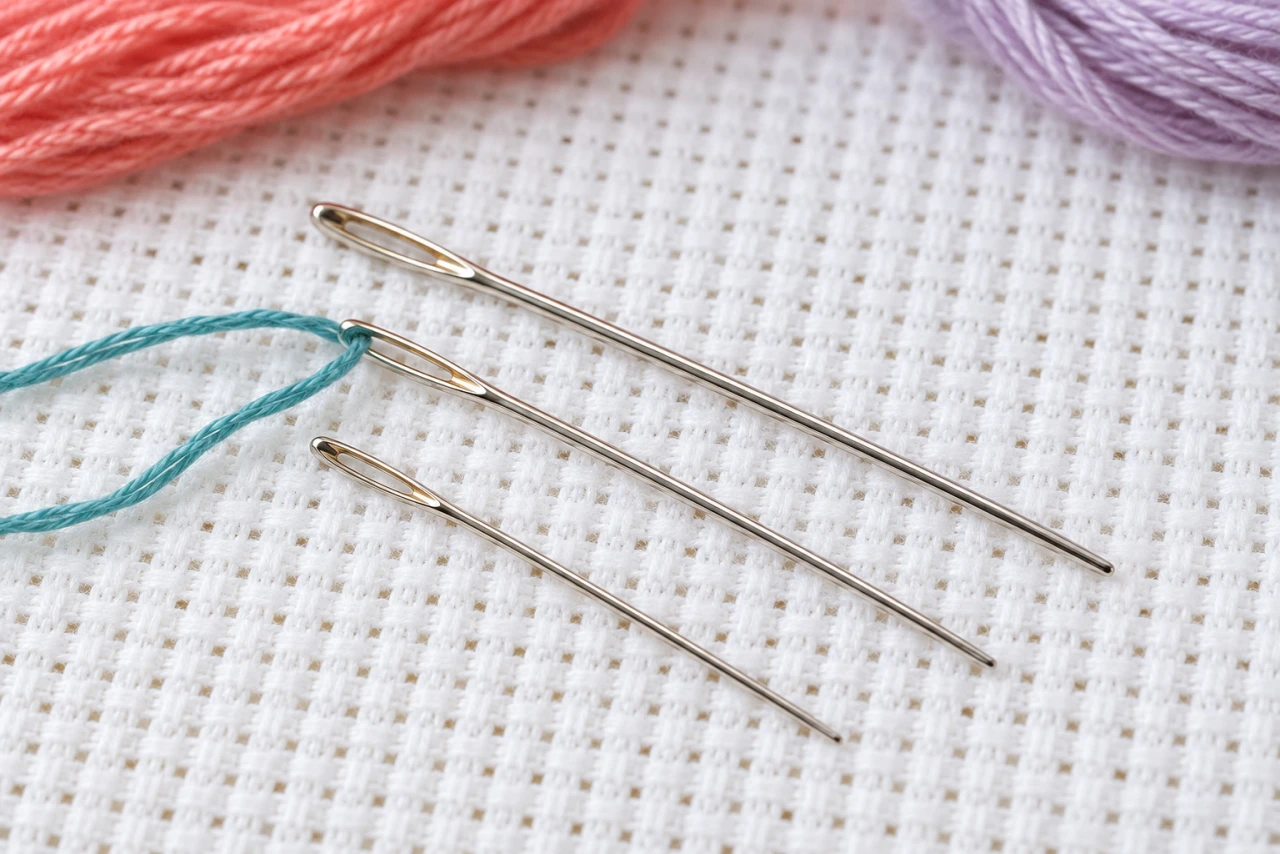
Start with the needle family
A packet marked “embroidery needles” can contain sharp crewel needles intended to pierce fabric. A tapestry needle has a blunt point and a generous eye. The blunt point helps you find an existing hole between fabric threads without splitting them as you make full crosses.
The Embroiderers’ Guild of America’s needle guide explains this distinction and the different needle families. Keep a sharp needle available if a particular technique needs it, such as piercing the center of an Aida block for a quarter stitch. That doesn't make a sharp needle the default for every full cross.
Pick a starting size
Within the tapestry family, the larger size number describes the smaller needle. A size 28 is finer than a 24. Numbers from different needle families aren't interchangeable measurements.
| Fabric and ordinary stranded cotton | A sensible first needle to try |
|---|---|
| 14-count Aida, two working strands | Size 24 tapestry |
| 16-count Aida, two working strands | Size 26 tapestry |
| 18-count Aida, one or two working strands | Size 26 or 28 tapestry |
| 28-count evenweave worked over two, two strands | Size 24 or 26 tapestry |
Treat these as starting choices. Needle eyes vary, and a fluffy or metallic thread can need a different fit from cotton. Your pattern or specialty thread's instructions may give a more useful recommendation.
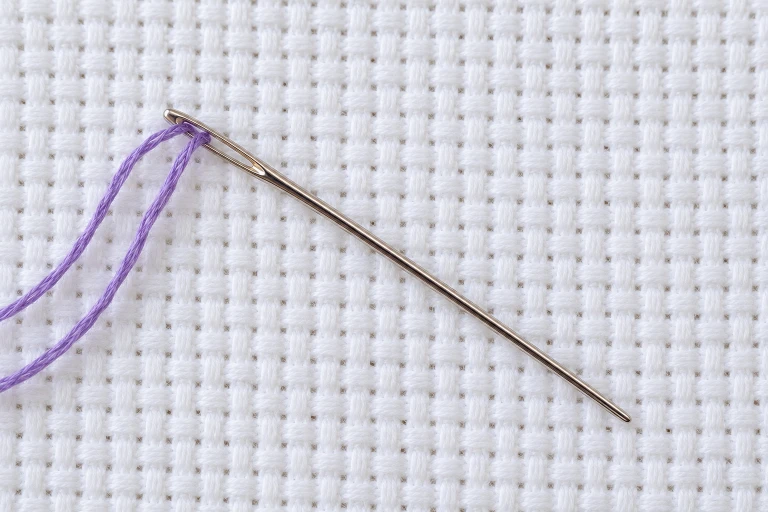
Eye and blunt point
The elongated eye holds the thread; the opposite end tapers to a blunt point.
Enlarge photoHow the needle should feel
With the chart's recommended strands in the eye, make a few crosses in a spare edge. The needle should pass through with a little resistance, without scraping the floss or leaving stretched holes. Keep the thread tail loose at the eye unless your starting method calls for folding it.
If threading is difficult, trim a fuzzy end and bring the strands together neatly. A roomier eye may help, especially with specialty thread. A wire threader needs room beside the doubled-back floss; don't force it through.
If the needle drags through the fabric, make sure you're entering an existing hole rather than piercing a fabric thread. Crowded holes can also resist the needle. For holes that stay enlarged, try a finer needle and ease your tension. On 18-count Aida, a size 26 or 28 will often be a better fit than a 24.
A needle that scratches or catches even in clear holes may have a rough spot or damaged eye. Replace it before it frays more thread.
Keep spare needles in their labeled packets so you can find the size again. For the next step, use our needle-threading guide. If you're unsure what “two strands” means, count the working strands before you begin.