
Count the fabric threads
Spread a small piece of linen or evenweave in good light. Find the individual threads running vertically and horizontally. The needle enters the spaces between them.
If you are used to Aida, take a moment to find the individual woven threads rather than looking for blocks. A hoop or frame can help hold the cloth flat while you learn the spacing. Keep the weave square; stretching it into a diagonal shape makes the holes harder to judge.
Choose a starting space and count across two vertical threads to another space. From there, count upward across two horizontal threads. Those are two corners on the same diagonal. Count the actual threads you pass over, rather than treating every visible opening as another complete cross.
Stitched Modern's linen guide includes the traditional starting-position advice of leaning against a vertical thread, often called a post. Its photographs can help you identify the over-and-under weave in actual cloth.
Trace four holes in order
The diagram marks a single cross. The pale lines represent fabric threads, and the four numbered dark holes are the corners you use.
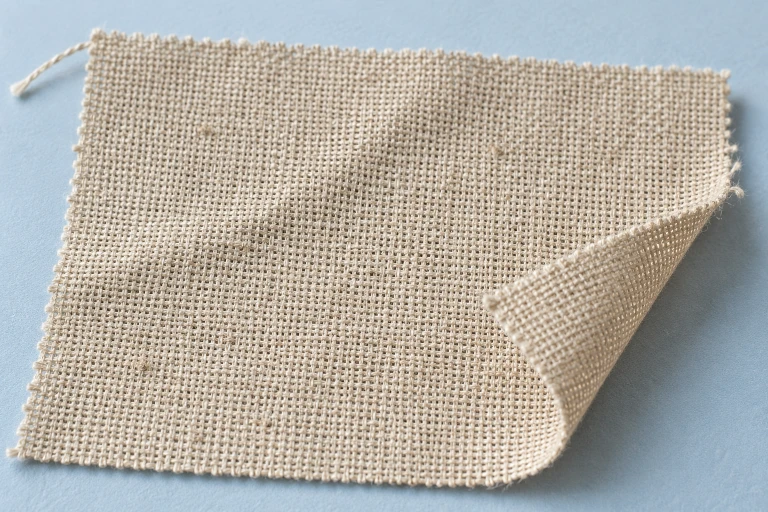
Individual threads in linen
Count the individual linen threads between the open spaces.
Enlarge photo
- Up at 1: start at the lower-left corner. Anchor the tail with a method suitable for your strand count and project.
- Down at 2: move across two vertical fabric threads and up across two horizontal threads, reaching the upper-right corner.
- Up at 3: come up at the lower-right corner, directly below 2.
- Down at 4: cross to the upper-left corner. This second diagonal lies over the first.
The front now has one X covering a two-thread-by-two-thread area. There is an unused opening midway along each side and one within the cross. Those intermediate spaces help you see the scale; they are not extra corners for this full cross.
For another cross immediately to the right, its left corners are the first cross's right corners. Count two more vertical fabric threads to find its outer edge. Keep the same top-leg direction.
Keep floss count separate
A pattern might say “two strands over two.” That means two working strands of floss form each cross, while the cross spans two fabric threads in each direction. It does not mean you should put four strands in the needle or make two Xs in the same space.
The floss instruction can change for backstitch or another detail even when the fabric spacing stays the same. Read both the stitch instruction and the material key. If you need to check how folding changes a strand count, our working-strand guide shows that part separately.
Check the size in stitches per inch
For an over-two full-cross design on an evenly counted fabric:
crosses per inch = fabric count ÷ 2
So 28-count fabric gives 14 crosses per inch, 32-count gives 16, and 36-count gives 18. A design 140 crosses wide measures 10 inches on 28-count over two: 140 ÷ 14 = 10.
Add spare fabric for your hoop or frame and the finish you plan; the calculation above gives only the stitched width. Use the fabric-size guide to work out the full cut.
If a pattern combines over-one details with over-two areas, use its instructions carefully. A tiny over-one face or lettering detail does not necessarily change the spacing of the rest of the chart.
Keep the spacing even
Three adjacent over-two crosses span six vertical fabric threads from the left edge of the first to the right edge of the third. If they span only three, you've worked over one. If a cross is wider than its neighbors, trace its corners and find the extra thread before continuing.
Once the spacing is familiar, long-armed cross stitch is another counted technique to try on the same kind of ground.