
Leave yourself room to finish
Stop while you still have enough thread to pass the needle under nearby stitch backs comfortably.
Turn the work over and find a small run of nearby stitch backs. For ordinary stranded cotton, passing under about four or five adjacent backs is a useful starting approach. Give the tail a light tug before trimming to check that those stitches hold it.
DMC's thread-security guide describes weaving under existing stitches and securing new starts by stitching over the tail. We'll focus here on ending a thread when a stitched area is already available.
Find a hidden route
Look directly behind the finished color block first. A route under nearby stitches keeps the tail out of blank fabric and avoids a long loose carry. Choose similar colors where possible, especially on light or open fabric where a dark finishing tail might show through.
The needle goes between the back of the fabric and the bars of thread already there. Slide under the bars without piercing the fabric or splitting their strands. The drawing shows those bars in gray and the finishing tail in turquoise.
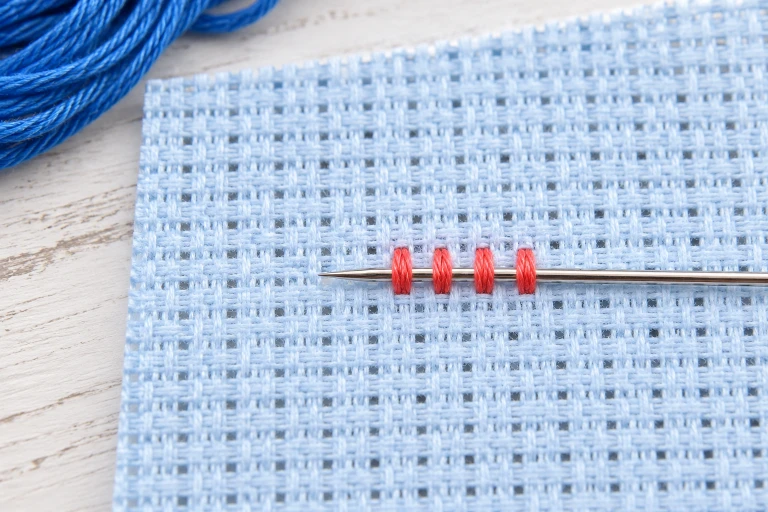
Under the stitch backs
Slide the needle beneath existing stitch backs, keeping it above the cloth.
View original photo
- Complete your final cross and bring the needle to the back.
- Identify the nearby stitch backs that will hold the tail.
- Slide the needle beneath several bars in one manageable pass. If the area is crowded, take a shorter pass and continue under the next backs.
- Draw the tail through gently, stopping while the fabric stays flat.
- Check that the tail is caught. Trim the loose end without touching the stitches that hold it.
Keep the scissor tips directed away from the cloth.
Before trimming
Turn the work face up. The finishing pass should leave no new diagonal, ridge, or dark line behind a blank area. If it pulls the stitches together, ease it out and choose a looser route. Give the tail a light tug on the back; if it slips, pass beneath another group before trimming. Smooth specialty threads may need the maker's securing method.
Ending beside an isolated stitch
One isolated cross provides less room to hide a finishing tail than a solid block. First check whether you can finish under a nearby stitched area without carrying thread across a visible blank space. A small change in stitching order may give you the neighboring stitches you need.
For a completely separate cross, use a method designed to finish beneath that cross. Avital Pinnick’s pin-ending tutorial and its replies describe both an anchor covered by later stitching and an option beneath an existing cross. Do not leave the first kind exposed in a permanent blank gap. Try the method on spare cloth before using it in a small isolated stitch.
Permanent knots can make bumps in a framed piece. Some washable clothing and household finishes allow small securing knots; follow the item’s construction and care instructions.
If you've already cut too short
Stop pulling at the tail. A fine needle threader may help guide a short tail under existing backs, or you can remove the last few stitches to recover a controllable length and stitch them again with fresh thread. Protect the fabric while doing either.
Once the end is secure, add the next thread with your chosen start. The folded loop method works well for suitable even-strand cotton; a stitched-over tail also works when the working strand count or a blend makes that fold unsuitable.