
The amount it shortens depends on the thread, thickness, and twist. A short trial gives you a better cutting plan than assuming the finished cord will be exactly one quarter of the starting length.
Prepare the doubled floss
Use ordinary six-strand cotton floss, scissors, a ruler, a pencil or smooth hook, and a secure temporary anchor. Keep the full six-strand bundle together for this example. Separating strands is useful for cross stitching, but this cord uses the whole bundle.
Cut a 120 cm trial length and fold it in half. Align the cut ends and secure them together at the anchor. Put the pencil through the folded loop and step back until the two 60 cm legs are straight under light tension. Keep the working area clear enough to hold this length without snagging it.

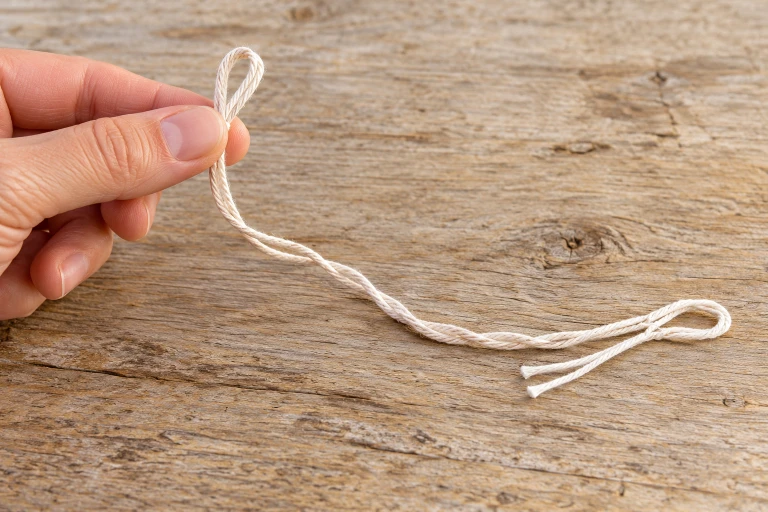
The new midpoint fold is at the left. At the right, bring the original loop and both cut ends together and secure them.
Enlarge photoIn the drawing, A marks the two anchored cut ends and P marks the original loop around the pencil. M will be the new midpoint fold in the second stage.
Use an anchor that holds without slipping as you turn the pencil.
Twist, then let the halves meet
Rotate the pencil consistently in one direction. Keep the two legs together and under enough tension to stay extended. Pause occasionally and reduce tension slightly near the middle: when the released section starts to coil back on itself, it is ready to fold.
Hold the midpoint M of the twisted length firmly. Bring the original pencil-loop end P toward both anchored cut ends A, keeping that midpoint controlled. The two halves will wind around each other. Let that coiling happen gradually, then stroke the cord lightly from M toward the gathered A and P ends to distribute the twist.
Pinch the original loop P and both cut ends A together so they cannot unwind. While maintaining that grip, slide P off the pencil and release A from the temporary anchor. Tie an overhand knot in the entire gathered end, catching the original loop and both cut ends together. Secure the knot before relaxing your grip. The new midpoint fold M stays separate at the opposite end; it is not part of this knot. Twisting and folding have shortened the cord.
If one part forms a loose bulge, keep both ends secured and ease twist toward that section. If the whole cord is limp, unfold it under control and add a little more twist to the first stage. If it buckles into hard knots, reduce the twist rather than forcing the knots flat.
Measure the useful length
Measure the even cord between the folded end and the knot, allowing extra length to sew into your finish. If it is too short, use its finished length to estimate how much floss to cut next.
For a worked calculation, suppose a 120 cm trial yields 27 cm of usable cord, and a finish needs 40 cm including its attachment ends. With the same construction, the proportional starting estimate is 120 × 40 ÷ 27 ≈ 178 cm. You could start with 190 cm to leave some extra trimming room. Use your own measured length in place of 27. If you make a thicker cord with more bundles, measure a new trial before cutting the full length.
Attach a loop or an edge
For a hanging loop, fold the finished cord into a loop and decide its visible drop. Sew both cord ends inside the finish’s seam allowance, keeping the knot hidden. Take several stitches through each cord end. The joining seam alone may let smooth cord slide if it only wraps around the outside.
For a decorative edge, begin near a corner or another discreet join. Secure one end on the reverse, lay the cord along the edge, then couch it with a finer matching sewing thread. Take small stitches across the cord, settling them into its grooves where possible. Ease the cord around corners without pulling the fabric inward. Secure the final end before trimming, and conceal the meeting point on the back or beneath a small intentional decoration.
When cutting a shorter piece from a long cord, tie or tape it at two points and cut between them to keep both ends from unwinding.