
If the two counts differ, a square chart will produce a rectangle. Check both before choosing fabric for a circle, square border, or lettering.
Choose the right unit
On Aida, count the blocks between the main holes. One adjacent-hole interval is normally one full-cross width. On linen or evenweave, count individual fabric-thread intervals first, then account for whether the design will be worked over one or over two.
A 28-count linen label describes approximately 28 fabric threads per inch. Worked over two, that gives about fourteen cross-stitch intervals per inch. When comparing a measurement with the label, use fabric-thread count for both.
Use a firm ruler with clear scale marks and measure along a straight fabric row or column.
Count spaces between holes
Locate a starting hole or grid position and count twenty complete intervals. Mark the two endpoints with pins in an unused area or keep track on a separate note. You’ll count twenty-one hole positions, including the first and last, to measure those twenty spaces.
Measure from the center of the first position to the center of the last. Avoid starting at a ruler’s worn or rounded physical edge; use two clear scale marks and subtract their readings if necessary.
Repeat down the cloth. Use the same counting unit and number of intervals. Measuring a longer span makes a small reading error less significant. Keep the ruler straight along the fabric row or column.
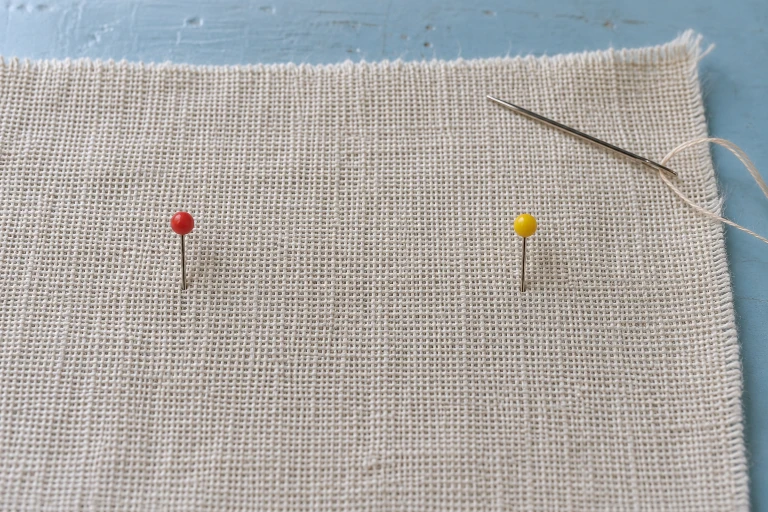
Mark the start and end in unused fabric, then count the complete spaces between them before measuring the span.
Enlarge photo
Scarlet Quince’s fabric-calculator instructions recommend measuring the fabric rather than relying only on the label, especially after the cloth has been washed and pressed.
Calculate both counts
Count equals the number of intervals divided by their length in inches:
| Direction | Intervals | Measured length | Actual intervals per inch |
|---|---|---|---|
| Across | 20 | 1.40 in | 20 ÷ 1.40 ≈ 14.29 |
| Down | 20 | 1.50 in | 20 ÷ 1.50 ≈ 13.33 |
If those are Aida blocks, they are also the working cross counts. If you measured individual linen threads and will stitch over two, divide each resulting thread count by two before calculating the design size.
For the Aida example, a 100 × 100-cross square would measure approximately 7.00 in wide by 7.50 in high. The height comes from the lower vertical count. A fabric with more intervals per inch makes the same chart dimension smaller.
Round the result to suit the ruler marks you can actually read; an estimated endpoint does not give an exact fabric count.
If the two counts differ, measure another area to confirm. Use both counts in your size calculation, or choose a more regular fabric for a design that needs to stay square. Stretching one axis in a hoop will not permanently correct an uneven weave.
Once you have the working counts, use them in the fabric-size calculation, adding the finishing margin separately.