
Read the product name as well as the color
Metallic thread can mean divisible floss, a ready-made braid, a fine blending filament, or another construction. The same instruction to use two strands can mean quite different things across those products.
DMC's metallic range distinguishes divisible Light Effects from non-divisible Diamant and other threads. Do not split a non-divisible product into the little components you can see within it. Those components form the thread. For a glossy thread without a metallic construction, DMC Satin needs its own preparation.
Read the pattern for both stitch type and exact product. A fine metallic used alongside cotton may be intended as an accent; substituting a thick braid can overcrowd the holes. If you want to substitute, try the actual combination on spare fabric first and check that you still like the effect.
Prepare one short length
For a Light Effects trial, try a 25 cm cut length, following DMC's advice to stay under 30 cm. Use the maker's length guidance for other metallic threads. Use a clean cut, separate the required strands, and put the rest back with their label.
For two working strands threaded conventionally, take two separated 25 cm lengths and place them together. Leave a tail through the eye long enough to stay threaded. Do not fold two strands in half and accidentally make four working strands.
A shorter length means ending and restarting more often. Plan the first trial near existing stitches or in a little group where you can secure the ends properly. Leave enough thread to secure both ends, even for a short decorative line.
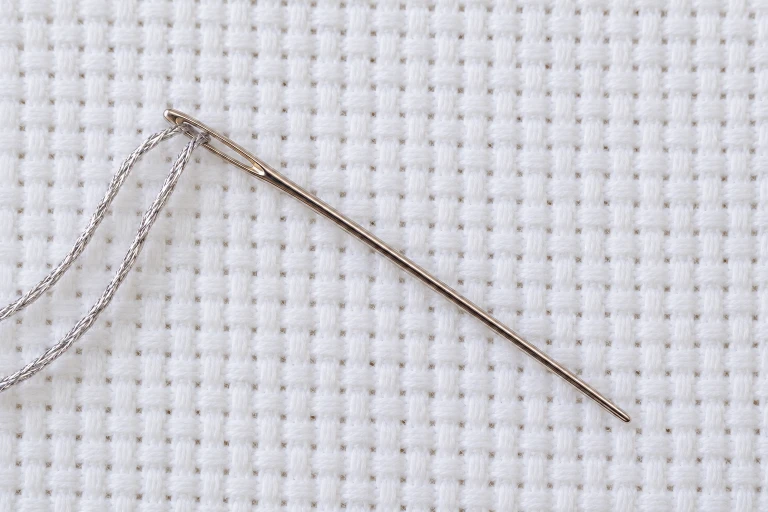
Metallic thread at the eye
Check that the thread moves through the eye without catching.
Enlarge photo
Choose a needle that fits the thread and fabric
Thread the needle without forcing the bundle or a threader through a small eye. A threader adds its own thickness. If it jams, back it out and reassess the needle rather than pulling harder.
The threaded needle should pass through the intended hole without a struggle or obvious enlargement. Changing to a needle with a larger eye may help, but the shaft must still suit the cloth. Moving to a much thicker needle simply to fit the thread can distort a fine fabric.
A few adjacent crosses on spare cloth will show how the thread handles shared holes, where new stitches pass beside existing floss. Keep the top legs consistent with the surrounding cotton.
Stitch a little group and watch the thread
Make a few crosses or a short section of backstitch, following the pattern's strand count. Draw the thread through in a controlled movement. If it twists into a coil, pause and let it unwind before making the next stitch.
Look at the working length occasionally. A rough end can catch on the eye and cloth repeatedly. End the thread while enough undamaged length remains to secure it, then begin with a fresh piece.
DMC's Light Effects guidance specifically connects shorter lengths with reducing fraying. For another product, follow its own handling and care advice. Check the maker’s advice before adding wax, conditioner, or heat; a treatment can change the finish and may be unsuitable for the thread.