If you love an X-shaped, gridded motif with fabric showing around it, we'd start by looking at cross-stitch patterns. If you're drawn to a canvas design, a filled background, or a mix of stitched textures, look at needlepoint. There is plenty of overlap: cross stitch can be full coverage, and needlepoint can use crosses or leave selected areas open.
Compare the stitches and materials
A full cross stitch has two diagonals that cross to make an X. Counted cross stitch commonly places one X for each marked square on a chart. Other instructions may add backstitch, fractional crosses, or embellishments, so check the stitch key before assuming a pattern uses only full crosses.
The Royal School of Needlework's cross-stitch entry shows both completing individual crosses and working a row of first legs before returning to cross them. In either approach, keep the top legs consistent unless the instructions call for a deliberate variation.
A tent stitch, widely used in needlepoint, makes one short diagonal on the front, usually across a single canvas intersection. Half cross tent, continental, and basketweave are different methods of working tent stitch. These methods look similar on the front but follow different routes on the back. Follow the method specified for your project; the RSN's continental guide explains that version.
Needlepoint isn't limited to tent stitch. The RSN canvaswork guide includes many decorative stitches. A design might combine short diagonals with longer stitches, repeated geometric groups, or other textures. “Needlepoint is half a cross stitch” misses that variety and the choice of ground material.
Compare Aida with needlepoint canvas
Aida has woven thread blocks with defined holes at their corners. Those blocks provide a clear grid for crosses worked over one block. It is a common cross-stitch choice, not the only one. Linen and other evenweave fabrics are also used, sometimes with each cross spanning two fabric threads. DMC's fabric guide explains these options.
Needlepoint canvas has an open grid. Mono canvas uses single threads in each direction; other constructions, including interlock and double-thread canvas, have different structures. Buy the canvas type the project specifies rather than treating every material described as “canvas” as a substitute.
The number on the label needs context. On 14-count Aida worked over one block, there are 14 crosses per inch. On 28-count evenweave worked over two threads, there are also 14 crosses per inch. For a tent stitch over one canvas intersection, the mesh number gives the approximate stitches per inch. Decorative stitches can span several intersections.
So an 18-count label alone doesn't make two materials equivalent. Check what is being counted, how far each stitch spans, the thread, and the finished size. Our fabric-size guide walks through the cross-stitch calculation.
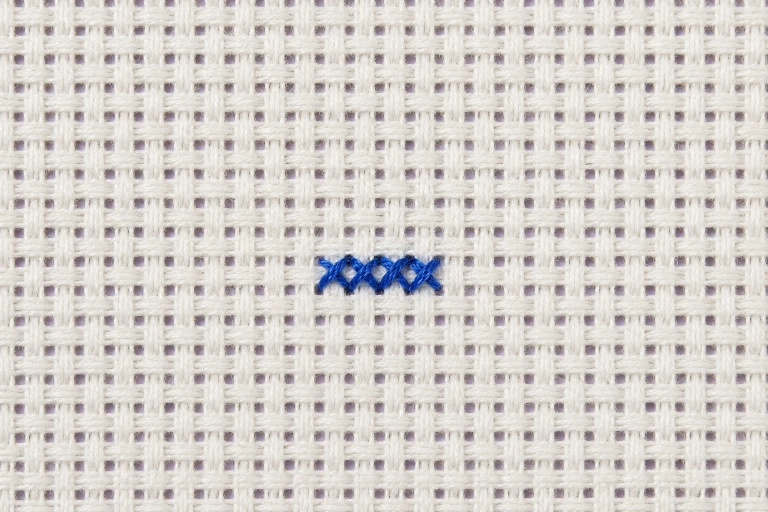
Full crosses on Aida
Each full cross spans one Aida block.
View original photo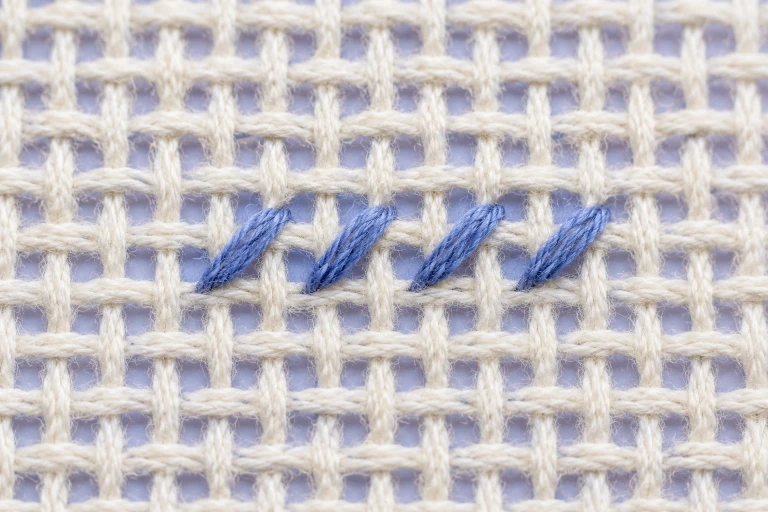
Tent stitches on mono canvas
Each short diagonal crosses a single canvas-thread intersection.
Enlarge photoWill you use a chart or a painted design?
Counted cross stitch usually starts on unmarked fabric: you follow a separate chart and count to place the stitches. Stamped cross stitch instead has stitch marks printed on the fabric. Read the instructions for any printed marks and their care; don't assume they all disappear in the same way.
Needlepoint can also be counted from a chart onto blank canvas, or worked on a painted or printed canvas. A painted canvas provides color placement on the ground itself, but may still need a separate stitch guide and decisions at color boundaries. It isn't automatically a complete kit.
For a concrete example, DMC's Floral Round Lattice canvas is described as stitch-painted, and the listing specifies that thread is separate. Check the contents list to see what you need to buy separately.
Compare the project requirements
| What to compare | Cross-stitch project | Needlepoint project |
|---|---|---|
| Ground | Often Aida, linen, or another evenweave; check count and stitch span | Usually open canvas; check construction and mesh |
| Main stitch | Full Xs, possibly with additional stitches | Often tent stitch, or a wider decorative stitch selection |
| Design instructions | Counted chart or stamped fabric, with a key | Counted chart, painted/printed canvas, or a combination with a stitch guide |
| Thread | Often stranded cotton; other threads are possible | Wool, cotton, silk, and other threads may be specified |
| Background | May be blank or stitched | Often stitched, but follow the particular design |
| Final work | Mounting, framing, sewing, or another chosen finish | May need blocking, mounting, sewing, or a specialist finish |
Neither craft has a fixed price or difficulty level. Compare the total project: fabric or canvas, thread quantities, needle, working support, instructions, and finishing. A canvas sold without thread and a kit containing most supplies aren't directly comparable prices.
Size alone doesn't tell you the workload either. A small full-coverage design can contain more stitches than a larger sparse motif. Many colors, scattered stitches, and unfamiliar techniques can change the work involved in either craft. For a cross-stitch time plan, use actual crosses and your own pace.
Choose a first project
Choose an image you like and the way you want to follow it: counting from a chart, following a painted canvas, repeating one stitch, or exploring several textures. A small motif with clear instructions gives you room to learn the material.
Look at the actual fabric or canvas if you can. Make sure you can see its holes comfortably and reach the working area. Include thread and finishing in the price, especially when a canvas is sold on its own.