
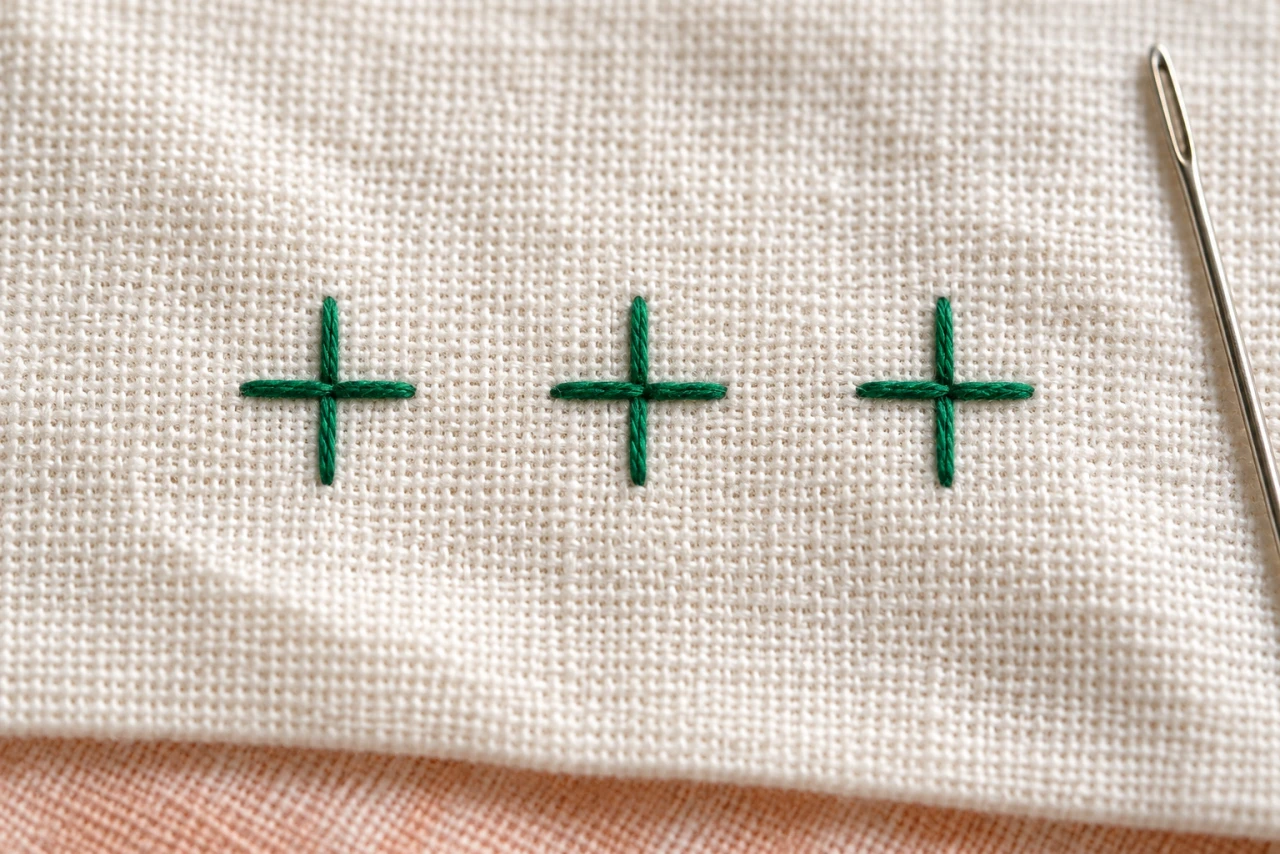
We’ll try size 8 pearl cotton in three upright crosses on 28-count evenweave. Each accent spans four fabric threads horizontally and vertically. The four-thread span leaves room for the thicker thread.
Read the size before choosing the setup
Pearl cotton is also called perlé or perle cotton. DMC describes it as non-divisible and offers sizes 3, 5, 8, and 12, with 3 the thickest and 12 the finest. Those numbers identify thicknesses; size 8 does not mean eight separable strands.

Choose a manageable length, about 35 cm for this first small trial, and thread the whole length through a suitable tapestry needle. A size 24 needle is a starting fit check on the chosen 28-count ground: the eye must accept the thread and the shaft must pass without forcing a large hole. Change the needle or setup if it drags.
Mark three accent centers
On a spare piece of 28-count evenweave, find a clear fabric-hole intersection for the first center. The next centers will lie six fabric-thread intervals to the right, all on the same horizontal line.
For each upright cross, its upper and lower endpoints are two fabric threads above and below the center. Its left and right endpoints are two threads either side. Each leg therefore spans four threads. Count the intervals, not the number of visible holes including both ends.
The first and third centers are 12 thread intervals apart. Including two intervals beyond each outer center, the whole three-accent span is 16 fabric threads, or 16 ÷ 28 × 2.54 ≈ 1.45 cm. Keep spare ground beyond it for holding and securing the tails.

Make the vertical leg, then the horizontal one
For a temporary start, tie a knot at the thread’s end. Put the needle down from the front about 10 cm away from the accent area, leaving the knot on the face. Bring it up at the first accent’s upper endpoint. That long reverse tail will be secured after the accents are complete; keep it clear of the working stitches for now.
From that upper endpoint, take the needle down at the lower endpoint to make the vertical leg. Bring it up at the left endpoint and down at the right endpoint to cross it horizontally. The horizontal leg lies uppermost. Leave the center unpierced by these two passes; the legs cross over that point.
Repeat at the next marked center, keeping the same order. The two-thread spaces between neighboring accents remain open. Avoid pulling a carry taut across those spaces: let the ground stay square and keep the reverse route short and contained.
On the reverse, slide the finishing thread beneath three completed stitch backs without piercing the front, then return beneath the last back in the opposite direction before trimming. Cut off the temporary knot on the face, draw its loose tail to the reverse, thread it into the needle, and secure it beneath the completed backs in the same way. Check both tails hold before trimming them close.
If the thread looks too heavy, try a finer pearl size. If it drags through the holes or draws the ground inward, change the needle or use a finer thread rather than pulling harder.
An accent made with pearl cotton will look different from a flat two-strand cotton cross. Try the raised, twisted line in a small part of the design before replacing an entire chart color. To use pearl cotton for a different texture, the chicken scratch lesson shows foundations and lacing on gingham.
Keep the pearl cotton’s size and shade with the remaining thread.