
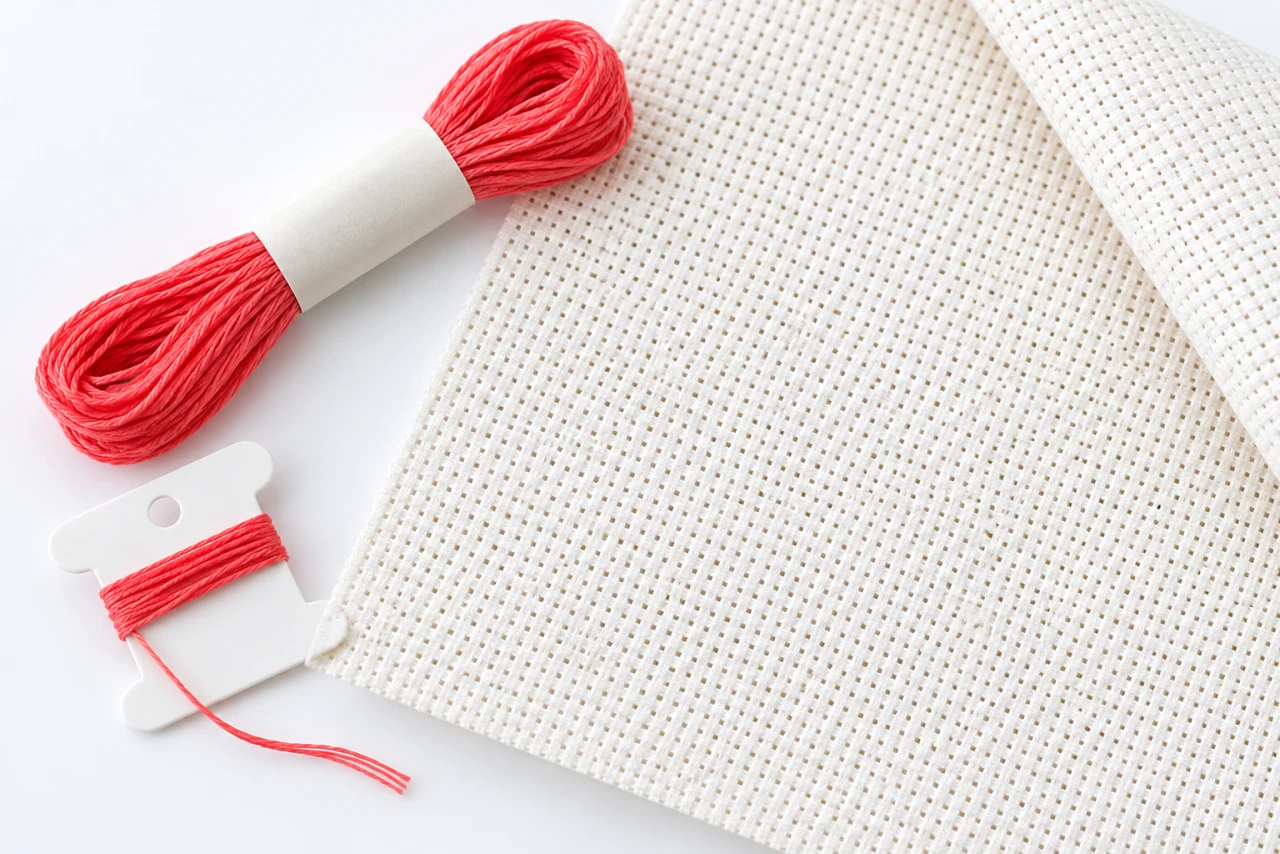
Stop before the last labeled piece is gone
Keep the brand, range, and shade reference readable. If available, retain batch or lot information too. A short labeled sample can help you compare another skein even after the main supply is used.
If the thread came in a kit, check the instruction sheet and supplied card. Some kits use position numbers that need a separate mapping to material references. A shop or kit maker can respond more usefully to the exact kit and color identifier than to a photograph of “the dark green.”
If the floss has run out much sooner than expected, look at the working strand count. Four strands use twice as much thread as two, and long carries between scattered stitches also use extra.
Compare the new skein with the work
Buy the same brand, range, and shade reference where possible. A matching number in another range or brand is a substitution. Compare the new material physically beside the labeled sample and existing stitches under consistent light.
DMC's FAQ describes its efforts toward consistency while noting occasional reformulations. The same number is the correct starting reference, but comparison is still useful, especially with an old project or hand-dyed material.
If there is a visible difference, avoid introducing it halfway across a large uniform area without considering the effect. You might reserve the new skein for a whole independent motif, seek a closer matching batch, or deliberately rework a bounded area. The suitable choice depends on where the color appears.
Keep the new skein labeled with the same chart symbol as the original.
Optional: estimate the remaining thread
For a large remaining section, you may want a closer estimate before buying. The worked example below includes an optional worksheet.
Worked example in individual-strand meters
Count the full crosses still needed, including isolated stitches. Allow for any unfinished legs too. A rectangular area 20 cells wide and 30 high contains 600 possible positions, but it has 600 crosses only if all those cells require that color.
Include other uses of the shade, such as backstitch or one component of a blend. Estimate these separately if their thread consumption differs. A rough count is enough for a rough estimate.
Scarlet Quince's calculator notes show why estimates depend on fabric count, strand count, route, starts, and ends. Its calculator is for its own patterns.
Count individual-strand length
Ordinary six-strand floss can be counted as bundle length or as the sum of its individual strand lengths. Choose one before doing arithmetic. Our example uses individual-strand meters throughout.
A 2 m length containing all six strands holds 12 individual-strand meters. Two already separated 40 cm strands add 0.8 individual-strand meters. Together, that is 12.8 m of usable individual strand length.
Do not call the same stock 12.8 m of two-strand working length. Two strands move through the fabric together, so 12.8 individual-strand meters would provide 6.4 m of paired two-strand length before allowing for unusable pieces and other losses.
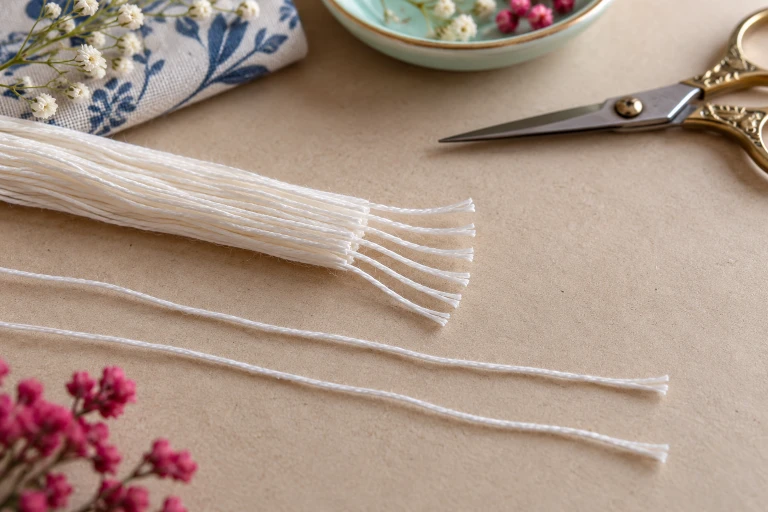
Count the individual strands
The bundle separates into six strands; two individual lengths lie below it.
Enlarge photo
Work out the amount
If you want a closer estimate, measure the working strands before and after stitching a small section. Add the length used from all strands, including starts, ends, and trimmings, then divide by the number of completed crosses.
Suppose a 40-cross section uses 0.8 individual-strand meters in total, including its starts and ends. That is 0.02 m per cross. These are example measurements; substitute your own values.
For 600 similar crosses, the estimate is:
600 × 0.02 m = 12 m
If you choose an additional 20% planning allowance for variation, the total becomes 14.4 m. That 20% is an example allowance, not a universal rule. A more scattered remaining section, more frequent starts, or several damaged partial lengths may need a different allowance.
With 12.8 m available, the example is 1.6 individual-strand meters short. Obtain more before continuing so you have enough for starts, ends, and any unusable pieces. Buy the next practical skein quantity above your estimate.
Our estimate worksheet separates the count, measured rate, allowance, and available stock. It is optional; keep the individual-strand units if you use it.