
Make the needle eye easier to see
Put the needle against a plain contrasting background and bring the light onto the eye. Dark thread shows well against white paper; pale thread may be easier against a dark card. Bring the needle closer or adjust your light until you can see the eye without hunching over it.
A smooth tapestry needle is suitable for ordinary counted cross stitch. An extremely fine eye can be difficult even when you use good technique. If you're forcing two strands through a tiny opening, check the needle size and fit before repeating the attempt.
Know what should pass through
Ordinary six-strand floss separates into individual strands. If your chart asks for two, take two out individually and bring them together again. Trim a fuzzy tip with sharp scissors.
For a two-strand start, pass one end of each strand through the eye and leave a short loose tail beyond it. Most of each strand remains on the working side. You have two strands making each leg of the cross.
For a two-strand folded loop start, use one long strand folded in half. Folding two strands would give four working strands.
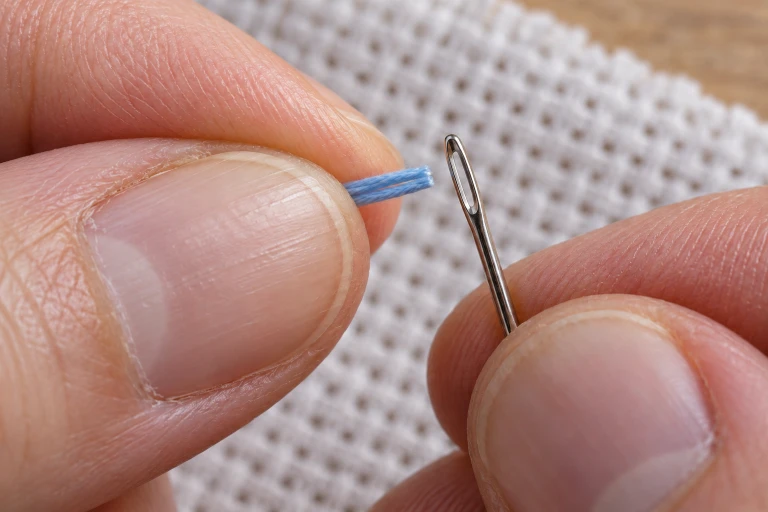
Align the tips
Pinch the ends together and bring the eye onto them.
Enlarge photo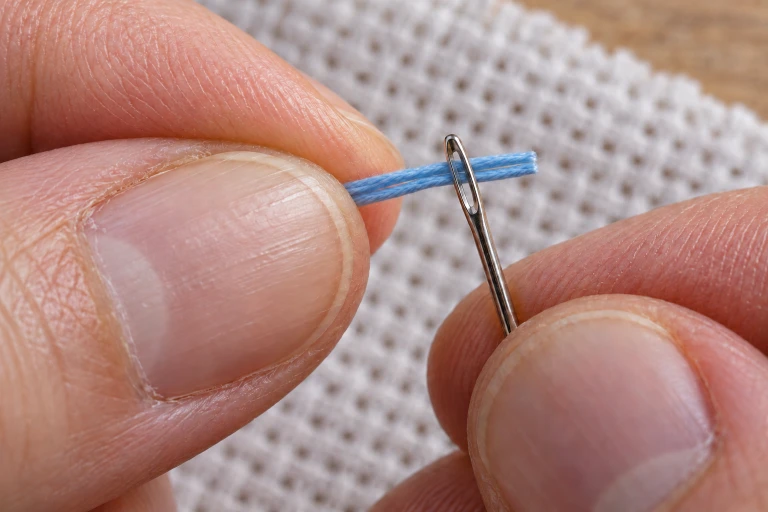
Draw the ends through
Once both tips pass through the eye, pull enough through to leave a short loose tail.
Enlarge photoUse the pinched-end method
- Hold the thread end between thumb and forefinger. Slide your fingers almost to the tip, leaving just a tiny end exposed.
- Hold the needle in your other hand with its eye facing that tip.
- Move the eye onto the thread. Keeping the thread still is often easier than pushing a floppy end toward a moving needle eye.
- Once the tips emerge, pull a short tail through the eye.
Recheck that the strands have gone through together. One strand left outside the eye can wrap around it and snag as soon as you stitch.
DMC illustrates this approach, a folded pinch method, and a hook threader in its needle-threading tutorial. The folded method uses the needle as a form to make a narrow bend in the end: pinch that bend, withdraw the needle, and put its eye over the pinched thread. Make this small bend at the end of the thread and leave the rest of the working length unfolded.
Thread with a hook or wire tool
Choose a threader that physically fits your needle. Put its wire or hook through the eye, lay the floss in the loop or hook, then draw it back through. Keep the floss close to the tool rather than making a thick tangled bundle.
Stop if it takes force. The returning wire carries a bend of thread as well as its own thickness. Try a finer threader or a roomier needle eye, keeping the strand count your chart requires.
When thread slips out again
A very short tail can slip back through the eye when you pull the first few stitches. Extend it by a few centimeters, then hold it gently as you begin. Keep the needle reasonably near the end of the thread instead of letting it slide to the center.
Don't make the tail so long that it gets caught in every new stitch. If a second little loop appears unexpectedly on the back, check whether the loose needle tail has been pulled through the fabric with the working thread. Free it before continuing.
If the thread repeatedly catches at the eye, examine the cut tip and the needle. Recut a frayed end. Replace a rough needle. Separating and recombining cotton strands can also remove a twist that made the tip spread apart.