
A frame on a stand or another stable holder gives both hands access to the work. Check that it stays in place when you let go, with room for a hand underneath.
Arrange the working space
Set the stitching area where you can reach both sides without raising your shoulders. Check that the clamp, stand arm, and chart holder do not block the underside of the small area you’ll use. Adjust the holder before threading the needle.
Keep scissors and a place to park the needle within reach. If you need to turn the frame to secure a tail, check how its own swivel or clamp releases. Don’t force a holder that is locked for stitching.
For the first few passes, put your familiar stitching hand above and the other below.
Make one round trip
Start the thread securely and bring it to the face at a lower-left corner. Make sure the upper hand has the needle before you release it below.
- The upper hand positions the point at the upper-right hole of the cell and sends it down through the cloth.
- The lower hand receives the emerging shaft. Release above, then draw the needle and thread through from below. Keep fingers out of the point’s route.
- From below, aim the point toward the lower-right corner of that same cell. Bring it up slowly so you can check its position on the face.
- The upper hand receives the needle and draws the working length through. Go down at the upper-left corner to complete the cross, using the same controlled exchange.
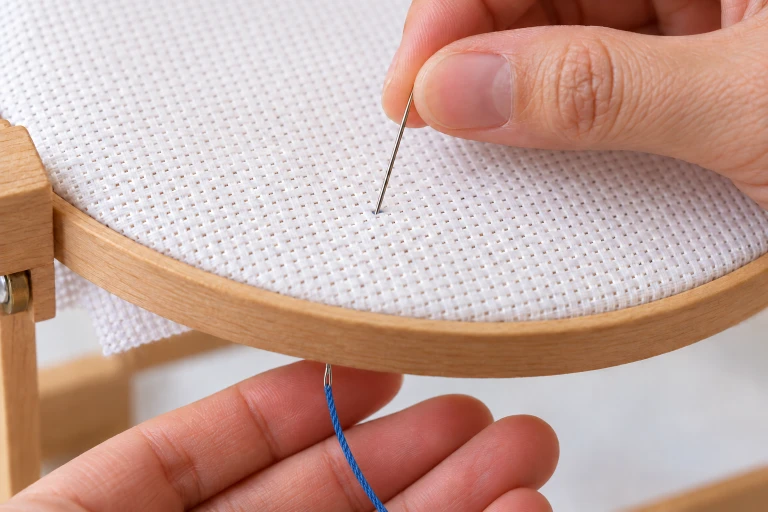
The upper hand receives the needle as it returns from below; the lower hand releases the threaded end.
Enlarge photo
Draw the loop through with the hand receiving the needle while the other releases it. Pulling from both sides at once can tug the cloth or split the floss.
Continue with either stitch order
Keep the same hand above and the other below as you move to the next cell. The exchange works with individual crosses or rows of lower legs. Either hand can work on top; choose the arrangement that gives you the clearest view and easiest return.
Donnett’s two-handed EZ Stitch demonstration shows a scroll frame leaving both hands free. Follow your own holder’s instructions for its clamps and rotation.
When the point appears beside the hole
Ease it back below the fabric rather than dragging the point sideways through the weave. Reposition from below and guide it toward the known opening. On a light scrap you can watch for the point before it fully emerges; keep the movement slow enough to correct it.
If your receiving hand repeatedly searches too far away, shorten the distance the needle travels before the catch and keep that hand close to the work.
If the holder rocks or moves, stop and adjust it. Bring the working area closer or tighten the frame connection as its maker directs. If you still have to hold the frame with one hand, adjust the support before trying another handoff.