
Choose a guide the garment can tolerate
Traditional waste canvas has threads you pull out; water-soluble canvas dissolves. Read the package for the exact removal time and temperature, then make sure the garment, floss, dyes, trims, and interfacing all allow that treatment.
DMC’s Water Soluble Guide is a flexible 14-count polyvinyl-alcohol guide basted in place and dissolved in warm water. Other guides may have different directions.
Start on a stable area of cloth
For a first project, choose a small flat area of stable washable cloth. A stretchy garment can change shape beneath the fixed guide and leave the stitches distorted. Keep the base fabric relaxed rather than pulling it tight to make the holes look square.
Plan the motif at the guide's count
A guide with 14 full crosses per inch makes a 21 × 28-cross motif 1.5 × 2 inches, approximately 3.81 × 5.08 cm. Sketch that rectangle on paper and test the placement. Count using the guide holes, even if the garment’s weave is visible underneath.
Leave extra guide around the motif for basting and handling. Keep the design clear of a seam, pocket, or thick hem that would make the needle path difficult. For a tote bag, separate the front from the back so you don't stitch both sides together.
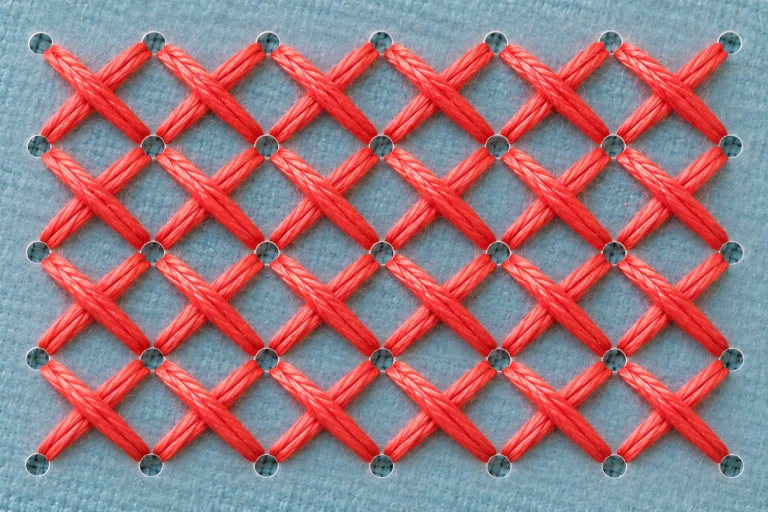
Guide in place
Each cross uses four neighboring round perforations in the thin guide.
Enlarge photo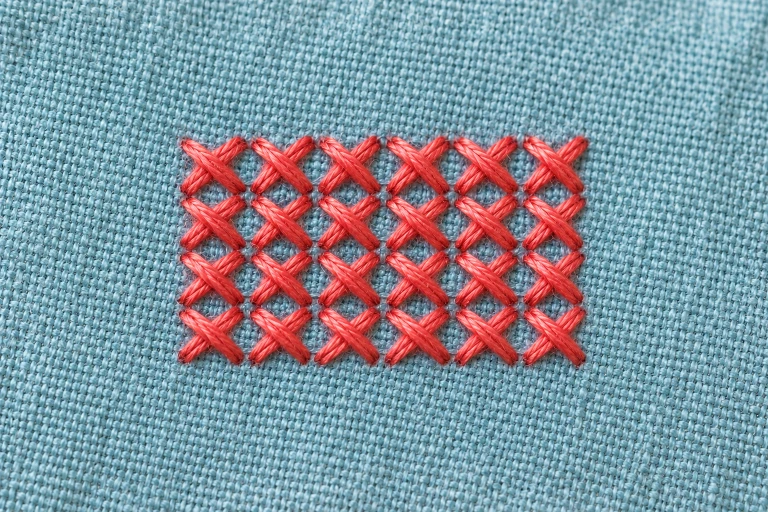
Guide removed
After the guide dissolves, the stitches remain directly on the garment.
View original photoBaste and stitch without shifting
Align the guide with your paper placement and tack it through the base fabric using large temporary stitches outside the design. Check the garment's natural grain or edge as well as the guide's grid.
Stitch through the designated holes and the base fabric. Keep tension even, checking the reverse and the guide position after the first few crosses. If a stitch only catches the guide, it won't be anchored to the garment once the guide dissolves. Correct that early.
Secure thread ends through the embroidery or a suitable hidden area of the base fabric. Don't rely on the soluble sheet to hold a finishing knot or tail permanently. Remove temporary basting once it is no longer needed and before the removal stage when the product directs.
Dissolve according to the package
Use the specified water treatment and support the garment while handling it. Let the guide dissolve fully rather than tearing the softened sheet out from beneath the stitches. Rinse as directed until remaining guide material has been removed.
If the embroidery still feels stiff after drying, inspect for residue and revisit the exact product instructions before adding heat. Do not increase the water temperature beyond the material instructions. Contact the manufacturer when its instructions and the garment care conflict.
Dry the piece as its materials require, with the fabric relaxed. Traditional waste canvas offers a different removal route when a dissolving sheet isn't the right fit for the project.