
We’ll use an original diamond repeat inside a larger diamond outline. The straight sides make the cut-off points easy to count before you try the same principle in a curved leaf or flower.
Choose where the repeat starts
Use light evenweave or linen and one strand of dark cotton. Our chart uses A, DMC 3810, Dark Turquoise, for the fill and B, DMC 310, Black, for the outline. Choose a needle that passes through the intended holes without splitting the ground threads.
Every grid interval in this exercise spans two fabric threads. The outside diamond fits an 8 × 8 grid of these intervals. Its vertices are (4,0), (8,4), (4,8), and (0,4), measured from the top-left of the enclosing square.
The filling diamonds each have a two-unit radius: for example, the central one joins (4,2), (6,4), (4,6), and (2,4). Their centers repeat every four units horizontally and vertically. Keep that same spacing at the edge.

Open the color-only chart. Use the same turquoise fill and black outline key in either view.

Make the boundary first
You can use backstitch for this first counted outline; keep each segment short enough to sit against the cloth. If you're starting on bare cloth, the away-knot setup in our double-running lesson gives you a tail to secure beneath the line once it's stitched. The diamond has four sides, each moving four intervals across and four down or up. Make one diagonal backstitch per interval along each side, sixteen outline stitches in all.
Blackwork Journey’s Mini Guide describes outlining freestyle shapes and filling outward toward their edges. The counted diamond below gives each clipped line an exact endpoint.
Find the center (4,4) and the four vertices of the central filling diamond. Stitch that complete diamond, using short counted line segments that follow the grid. Keep the thread ends secured within the stitched line or another suitable stitched area.
Follow the repeat toward an edge
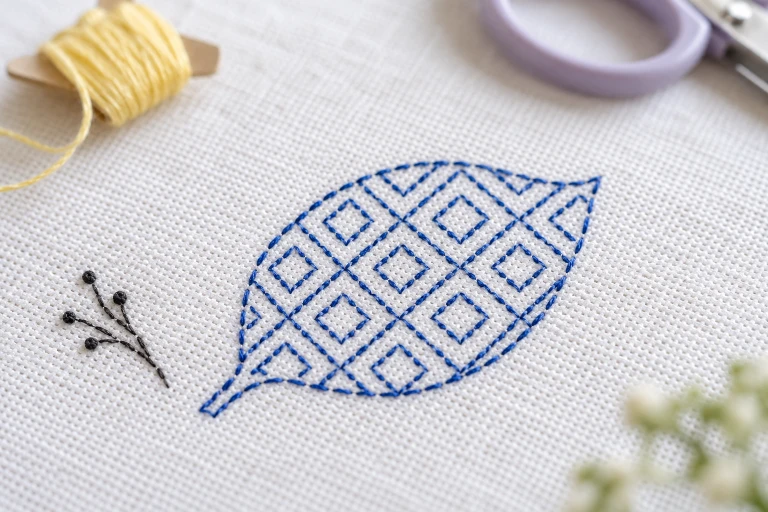
At the outline, keep the repeat aligned and stitch only the portions that fit inside the shape.
Enlarge photoThe next filling diamond above has its center at (4,0), on the top tip of the outline. You do not move it down to make a complete diamond. Only its lower point and the short parts leading toward that point fall inside the boundary.
Compare these three positions:
| Repeat location | What stays inside | What to do |
|---|---|---|
| Center (4,4) | All four sides | Stitch the full filling diamond. |
| Center (4,0) | Lines (3,1)–(4,2) and (4,2)–(5,1) | Stitch those two short segments only. |
| Center (0,4) | Lines (1,3)–(2,4) and (2,4)–(1,5) | Keep the same origin and stitch the two right-hand remnants. |
The right and bottom edges follow the same geometry. The complete fill contains twelve turquoise segments: four around the central diamond and two at each of the four outer directions.
When a segment reaches the outline, end that segment at its boundary hole. Do not continue through the shape’s exterior just to complete the repeat. On a less geometric outline, a sensible stopping point might be the last intended hole inside it rather than a full-sized repeating unit.
Keep thread carries out of open areas
Plan how to reach each section of the fill. You can work suitable sections in backstitch or plan outward/return passes. Before carrying to another section, check where that thread would show through the open ground.
For this small practice, secure the thread at the end of a separated section and restart rather than dragging a visible dark diagonal across the open spaces. If you want a reversible line, plan the double-running route before stitching and check both faces.
Recognize a shifted repeat
Count four grid intervals from the center diamond to the next diamond’s center, even where most of that diamond falls outside the outline. Moving that center toward the boundary crowds the edge.
If one remnant looks longer than its partner, locate its endpoints on the chart before adjusting the surrounding fill. Our upper remnant begins at (3,1), not (2,0); the part above that point lies outside the outline. Remove the extra segment instead of moving the whole pattern.
The same principle works inside a curved leaf or flower: keep the repeat spacing and stop each edge line at the last suitable hole inside the curve.