
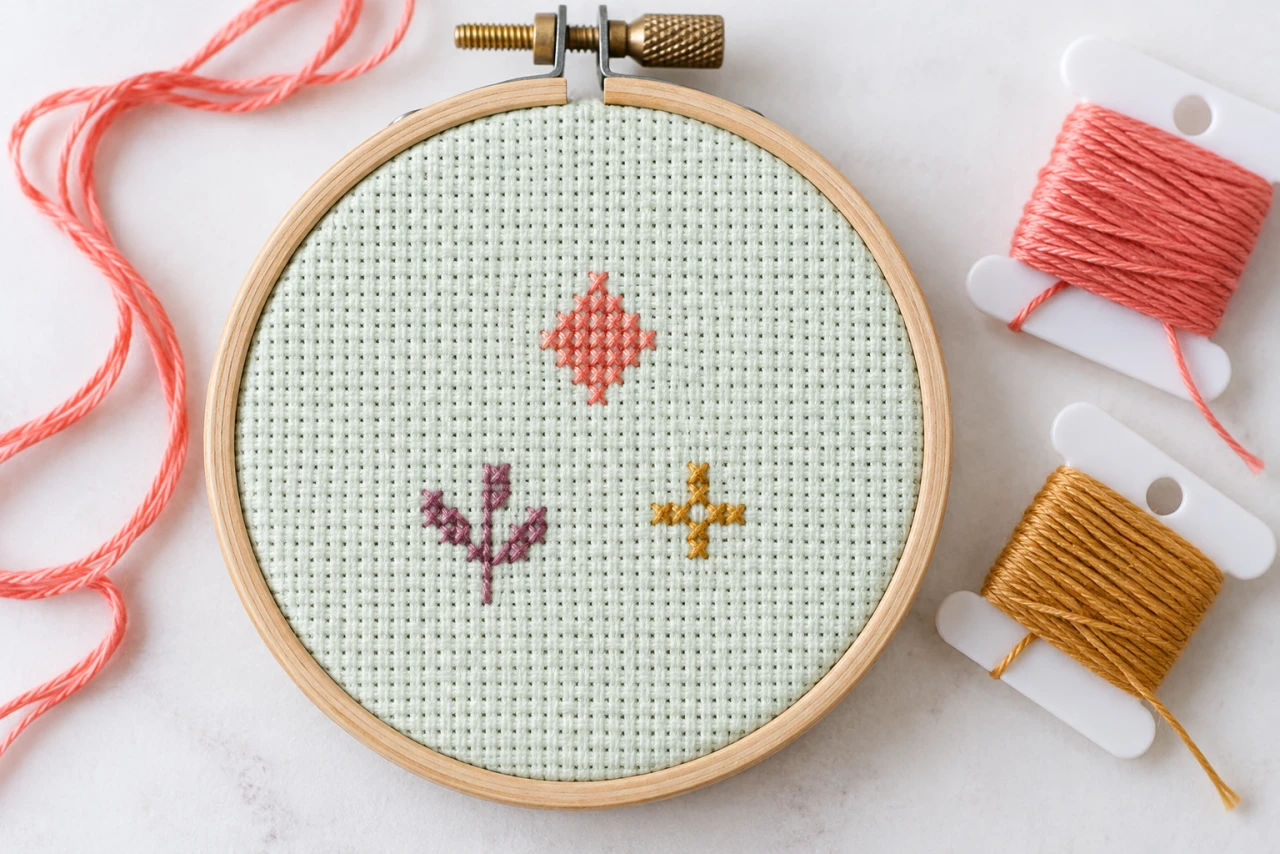
We'll combine two little sprouts with a central diamond. All three are original full-cross motifs. Both sprouts sit one row lower than the diamond, with equal gaps on either side.
Start with motifs you can reuse
Use your own designs or motifs whose terms allow the intended use. Keep the source and permission notes with the chart. A motif available to stitch isn't automatically available to redistribute as part of a new chart.
Copy the actual cell grid and its key, including meaningful blank rows. A cropped picture of stitched work won't tell you reliably which small gaps were intended. Keep special-stitch instructions with the motif too.
Our sprouts each occupy a 3×5 box. The diamond occupies 5×5. They're full-cross-only designs, so we can combine their occupied cells without merging line endpoints or fractional stitches.
Draw the outside box
Use a 17-column by 8-row working grid. Number its columns and rows from 1. The center of this box lies in column 9, between rows 4 and 5.
Place the diamond in columns 7–11 and rows 2–6. Put the left sprout in columns 2–4 and rows 3–7; the right sprout goes in columns 14–16 and rows 3–7. This leaves two blank columns between the motif boxes on each side of the diamond.
The sprouts' centers sit six columns to either side of the diamond's center. They're one row lower, so the diamond sits slightly above the two sprouts. If you want a straight top edge instead, align all three box tops on row 2 and check the resulting balance.

Open color-only chart · Download the combined grid and motif positions

Check the thread key before pasting
Our teal uses X for DMC 3812, Very Dark Seagreen, and the pink uses O for DMC 3833, Light Raspberry. Each thread color has one symbol throughout the combined chart. Blank cells stay unstitched. If two source motifs call the same material by different symbols, choose one symbol and update both. Keep different threads listed separately even when their colors look similar. Combine them only if you have chosen to use the same thread for both.
In some chart editors, a pasted motif adds its colors to the destination palette. Ursa's motif guide explains that behavior in its software. Check that the combined key still lists the correct thread for every symbol. On a paper chart, update the thread key by hand.
Place the arrangement on fabric
Our layout has 27 crosses: seven in each sprout and thirteen in the diamond. Most of the space between the motifs remains open cloth. End and restart thread when a carry through a large open gap would show.
Before stitching, locate this whole box on the fabric with its finishing allowance. Mark the whole arrangement’s center on the chart, then line it up with the fabric center. It isn't necessary to start stitching at that exact center if the nearest cross is somewhere else.
Make a change without losing the layout
Suppose you want a four-cell gap instead of two. Moving each sprout two cells outward adds four cells to the whole width. Use a 21×8 box, keep the diamond centered in columns 9–13 and place the sprouts in columns 2–4 and 18–20.
A longer name or directional picture may suit uneven gaps. Move the boxes on the chart until you like the whole arrangement.
Save the finished chart with its complete key. The chart-sharing guide covers what to include when sending it to another stitcher.