
Start with the picture's structure
Choose the areas that need to remain separate. In a simple flower, the petal, center, leaf, and outline may each have a different role. In a portrait, several nearby skin or fur tones may matter more than a bright accent.
Sketch those areas before choosing floss numbers. Ask where the lightest and darkest parts belong, which shapes must remain distinct, and where a small accent will draw attention. The number of colors follows those needs; four isn't a target every design must meet.
A three-color bloom
The bloom below has petals, a center, a stem, and leaves. Keep those cells fixed while trying different colors, so you can see what each change does to the same picture.

| Symbol | Role | DMC code |
|---|---|---|
| • | Light center | B5200 |
| + | Petals | 3689 |
| × | Leaves and stem | 3812 |
Compare the actual skeins on the fabric you plan to use.
Check light and dark before adding more shades
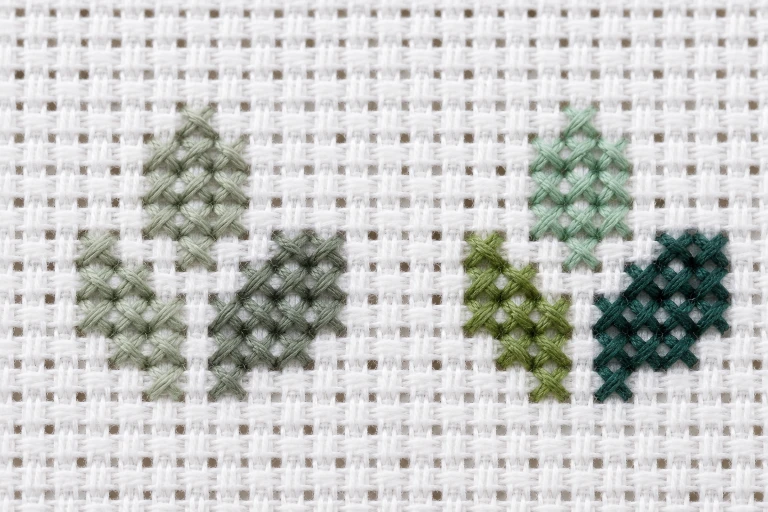
Compare the colors in the same shapes and check whether adjacent areas remain distinct.
Enlarge photoLook at the motif from a little farther away. Can you still separate its main shapes? If two neighboring colors merge, adding a third very similar color may not solve the problem. A larger light-dark difference, a clearer boundary, or a different background may help more.
In the bloom, compare the leaf directly with the petals. A leaf color can be attractive on its own yet too close to the petals once the two meet in small stitches.
A grayscale view can help inspect light-dark structure, but it doesn't describe every physical color relationship. Compare the colors on the fabric as well.
Decide where to use an accent color
A small accent can draw attention to a flower center or another detail. Check how often it appears in the chart. Repeating it across a background can add many isolated stitches even when it looks like a small change.
In this bloom, the center has five cells. Adding a dotted background of forty separate crosses would introduce forty isolated stitches. If your goal is a clear focal point and a simpler stitch route, retain the center accent and leave the dotted background out. If those background dots are important to the design, keep them and allow for the extra stitching.
Save the key with the grid
Keep the thread brand, range, floss number, and chart symbol with the saved grid. Add a changed shade to the key so the chart and floss agree.
The Thread Bare charting guide shows how palette choices interact with chart detail. Our substitution guide focuses on changing one color while checking its neighbors.
View the motif at its finished size with the fabric visible through the blank cells. Those open areas are part of the color scheme too.
Open the color-only bloom or save the grid and versioned thread key.
