
Name the two legs
A full cross contains two diagonal stitches. The first lies underneath; the second lies on top where they cross. When stitchers talk about crosses facing the same way, they usually mean that visible upper diagonal.
For our example, make the lower leg from bottom left to top right, then the upper leg from bottom right to top left. Seen on the face, the lower leg is / and the upper leg is \.
The Scarlet Quince basic-cross tutorial explicitly accepts either convention when it is used consistently. A chart or specialized technique may specify something more particular, so check the instructions before adopting a default.
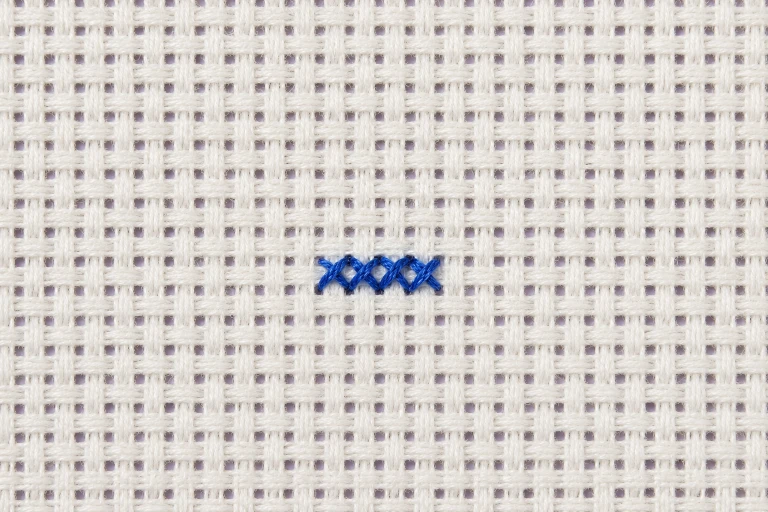
Consistent upper legs
The upper diagonals all lean the same way. Keep that direction as your needle route changes.
View original photo
Check the upper leg as you change direction
Moving the needle from left to right doesn't automatically give a particular upper leg. Each diagonal connects two opposite corners, and you can travel along that diagonal in either direction.
Imagine the upper leg joining bottom right and top left. The visible line is the same whether the needle goes up at bottom right and down at top left, or up at top left and down at bottom right. The back route changes, but the upper leg still leans \.
This is helpful at a row end. You can change your working direction without changing which diagonal belongs on top. Think “which pair of corners is this leg joining?” rather than “which direction is my hand moving?”
Start a row deliberately
If you use the row method, make a run of the same lower diagonal first. Cross those diagonals on the return pass with the opposite diagonal. Check the first two completed crosses before continuing across a large block.
For a single-cross method, finish both legs of one X, then move to the next cross. Again, keep the same upper diagonal. Our rows-or-individual-crosses guide walks through both routes.
If you tend to forget the upper-leg direction between sessions, draw an X in the chart margin and mark its top diagonal.
Change direction without mirroring the design
A left-handed stitcher can choose a comfortable needle route and still put the same diagonal on top. You don't need to reverse the chart unless the pattern actually asks you to. Mirroring a chart would also reverse letters and move asymmetric details.
If a video demonstration is uncomfortable to copy, pause at the finished leg and identify its two corners. Work between those same corners in the direction that suits your hands. Keep those endpoints and the leg order; use the grip that lets you reach them comfortably.
If one upper leg points the other way
Check whether it is an ordinary full cross. A half cross or a deliberate texture change may be meant to differ. Don't add a second leg to a half stitch simply to make its direction match the full crosses around it.
For one accidentally reversed full cross, remove its upper leg carefully and then examine the lower one. To change which leg sits on top, you may need to remake both legs in the correct order. Adding a third diagonal over the whole cross leaves extra thread and a different thickness.
When a whole block has been worked the other way, consider how it looks and how much unpicking would be needed. For a decorative piece, you can decide whether the difference matters enough to unpick. If later stitches or backstitch run through that block, check whether you can remove those threads without disturbing more of the work.