
Find the center of one square
On Aida, the ordinary holes mark the corners of each block. A quarter stitch needs a point inside the block, so the needle may need to pierce its center. A finer sharp needle can make that placement easier than forcing a large blunt needle through a dense block.
On linen or evenweave worked over two threads, the center falls at the intersection between those counted threads. Keep counting carefully so a fractional stitch doesn't drift into a neighboring square.
Use a comfortable fabric count and enough light to identify the center. Enlarging the chart helps you read the instruction, but it doesn't enlarge the cloth hole you need to make.
Find the corner shown in the chart
A small symbol in one corner may indicate a fractional stitch. Use the key and surrounding outline to find the required corner and color. Two colors in a square may mean paired fractionals or another treatment specified by the designer.
Look at which shape the color belongs to. A quarter stitch can soften a curve, mark a tiny detail, or finish an edge. This is useful context, but it doesn't override explicit chart instructions.
Cloudsfactory's fractional-stitch guide shows the difference between a corner-to-center arm and a three-quarter construction. The example below starts with a lower-left quarter stitch.
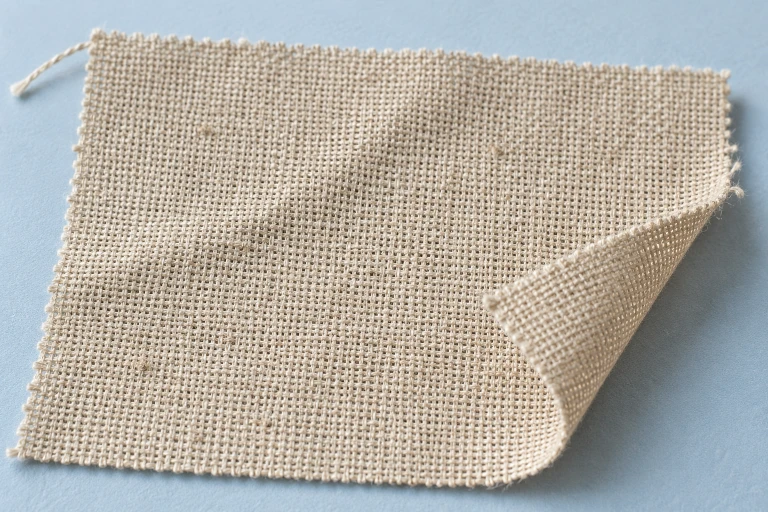
Individual threads in linen
On linen, the individual fabric threads and the spaces between them remain visible.
Enlarge photo
Make one quarter stitch
In our example, the required arm lies in the lower-left corner. Bring the needle up at that corner, then down at the square center. The thread covers half of the bottom-left-to-top-right diagonal.
You can work the same arm in the other direction if it is easier to reach; the visible endpoints remain lower left and center. Draw the thread through gently. A tiny stitch can disappear into the block if pulled too hard.
Check that the center point hasn't shifted toward the corner. The quarter arm should reach the middle rather than stopping at an arbitrary convenient gap.
Add the full diagonal for three quarters
Keep the same lower-left quarter arm. Now make the full diagonal from top left to bottom right. Together these cover three arms of an X: top left, bottom right, and lower left. The top-right arm remains absent.
The full diagonal lies above the short quarter arm in this illustrated construction. Make the order clear when two colors or a backstitch will share the center; crowded intersections can become bulky if you add thread without checking what the chart requires.
A half stitch has only one full diagonal, as shown in the middle diagram.
Fit two colors into a square
Suppose the top-right corner is background and the other three arms belong to an object. One possible treatment is a background quarter from top right to center plus an object three-quarter in the remaining arms. The two colors meet at the center.
Some designers instead specify two quarter stitches separated by a backstitched outline, or a different arrangement. Use the chart's convention. Don't automatically give every object a three-quarter stitch or add a diagonal beneath every outline.
If the key does not explain how to combine the colors, ask the designer before stitching the section. Once you know the route, a small test on spare cloth can help you judge its appearance.
Fix a split strand or bulky center
If the needle has split a strand from a neighboring stitch, reverse that movement before tightening. Ease the thread out and approach the center with a clearer view. A sharper or finer needle may help where you must pierce Aida, but keep it from piercing existing floss accidentally.
If a fractional cell looks unusually thick, count its arms. A three-quarter plus a quarter supplies four arms between them. Adding another complete diagonal can give unwanted extra coverage and change the edge.