
The movement is easiest to see with two strands of ordinary cotton. Railroading concerns the strands within one leg; you can still choose to work rows of lower legs or complete each cross individually.
Prepare two separate strands
Separate a length of floss into individual strands, then recombine two. Thread them together through a suitable tapestry needle. Let the needle hang briefly if the bundle has twisted on itself.
Start securely and keep your usual upper-leg direction. A scrap of Aida is a convenient place to try the movement.
Bring the needle up at the first corner of a cross. Draw the thread fully through, then lay the two strands toward the destination hole. Spread them slightly with a fingertip or the needle so you can see a gap.
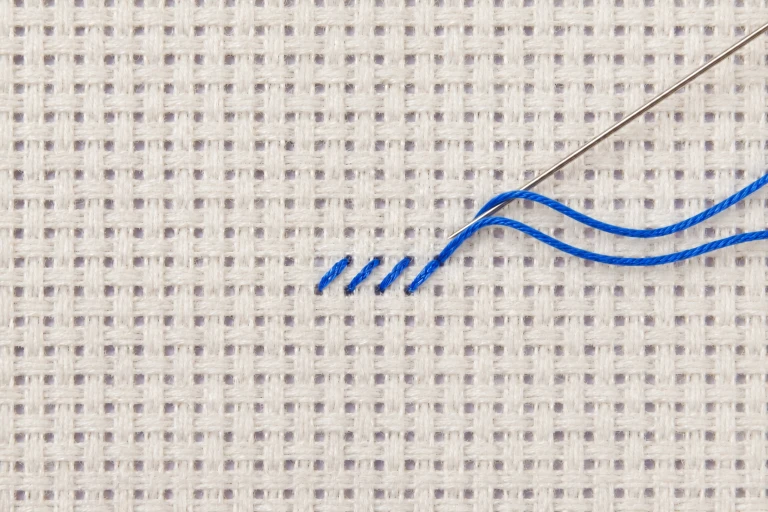
Place the point between the two whole strands, then enter the next diagonal hole.
View original photo
Pass the needle between the strands
Put the needle point through the gap between a and b. Keep the point away from the cotton fibers themselves. Move it to hole 2 and take it down through the cloth while it remains between the strands.
Draw the loop through steadily. Guide the strands so neither gets trapped beneath the other as they settle. Stop when the leg lies against the fabric; pulling harder does not help the two strands spread.
The completed leg has the same two endpoints as an ordinary leg. There is no extra securing stitch, wrap, or knot. If your needle has picked up only some fibers from one strand, ease it back out before tightening. Splitting a strand is different from passing between two whole strands.
Scarlet Quince’s railroading tutorial demonstrates the point-between-strands movement and explains that you can apply it to both legs, the top leg, or only a stitch that needs attention.
Use it where it helps
Try railroading just the upper leg first; that is the strand placement you see most clearly. You can use it for an area of solid color, throughout a project, or only when a stitch needs attention. If you like how your stitches lie already, there is no need to add the movement to every cross.
Untwist the strands if the gap closes
If the two strands remain tightly wrapped together, don’t jab at the bundle. Lift the needle away from the cloth and let the working length untwist. You can also slide the needle gently between the strands near their emergence to open a gap. Work slowly enough to avoid snagging the existing stitches.
If a tiny loop remains on the face, check whether both strands have drawn through. Ease the slack through gently; don’t pull hard against a caught strand. If the needle repeatedly finds fibers instead of a clear gap, shorten the working length and separate and recombine the cotton again.
For uneven crosses caused by different upper-leg directions or a tight pull, see the direction guide and tension lesson.
For a larger bundle, a laying tool can help guide the strands as you draw them through. Practice the two-strand movement before trying more strands.