
Follow a row in two passes
We'll use three adjacent cells and make / as the lower leg, \ as the upper. Adjacent cells share their corner holes.
Start at the lower-left hole of the first cell and go down at its top-right hole. On the back, move down to the lower-left hole of the second cell and make its lower diagonal. Repeat for the third.
You now have three half crosses. Come up at the bottom-right hole of the third cell and take the thread down at its top-left hole. Work back across the second and first cells the same way. The upper legs complete the three Xs.
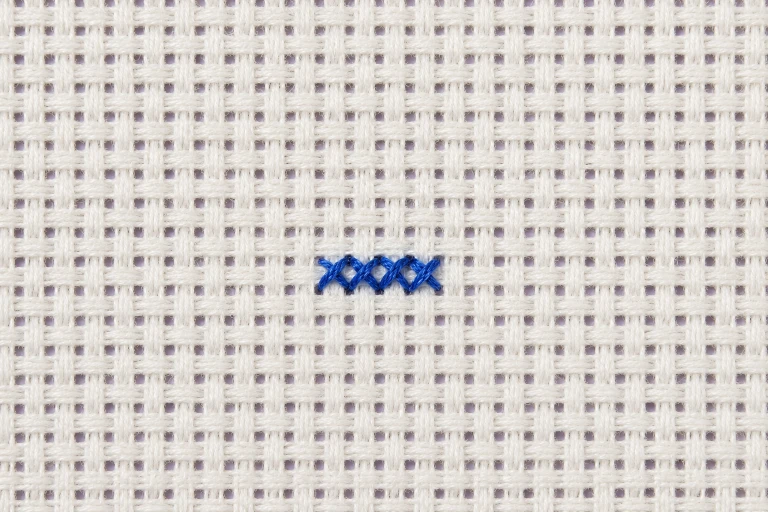
The completed crosses
Both routes finish with full Xs. The numbered diagram below shows how each route reaches that result.
View original photo
Finish one X before the next
Using the same upper-leg convention, make the lower diagonal and then the upper diagonal of the first cell. Move on to the second cell and complete it, then the third.
This route can make it easier to see which cells are finished when stitching an irregular edge or a small isolated group. A variegated thread may also benefit from completing each cross before moving on, because its changing colors then tend to progress through the crosses differently from a long out-and-back row. Follow your thread maker's or chart's direction where it specifies a route.
The Scarlet Quince stitch-path tutorial compares routes for solid rows, gaps, and irregular shapes.
Leaving a row unfinished
A two-pass row still needs its upper legs when you reach the far end. Mark those cells complete only after crossing them on the return. If you need to stop sooner, leave a small note showing where the top legs should resume.
You can mix both methods in a project while keeping the same upper diagonal. A rectangular block may suit rows; its stepped edge may be easier one cross at a time.
Plan where the thread will finish
Look at where the needle will finish. If a two-pass row would return you to the wrong end for the next section, try completing the crosses in one pass. Plan just the next small shape; you can choose a different route after it.
Handle gaps deliberately
The two-pass route doesn't require filling blank chart cells. If a row has three intended crosses, a blank cell, and another cross, the blank stays blank. Decide whether to travel behind it or finish and restart.
Carrying across unstitched cloth can show, particularly with a dark thread on a pale open fabric. A route hidden behind completed work may be more suitable. Our thread-travel guide helps make that choice.
When the top legs change halfway through
Compare the finished face before adding more. You may have reversed which diagonal you make first when you changed direction. Choose one convention and restore it for the next section. A misplaced half cross shouldn't be corrected by adding multiple diagonals until the cell looks filled.
If you need to unpick, remember the actual stitch order. In a two-pass row, several upper legs may sit over the lower leg you want to remove. Follow that route backward rather than pulling an underlying thread through intact crosses.