
A small repeated arrangement is a useful first layout: measure one central working area, place three motifs on the same center line, and check the blank gaps before threading the needle.
Measure the band that is actually available
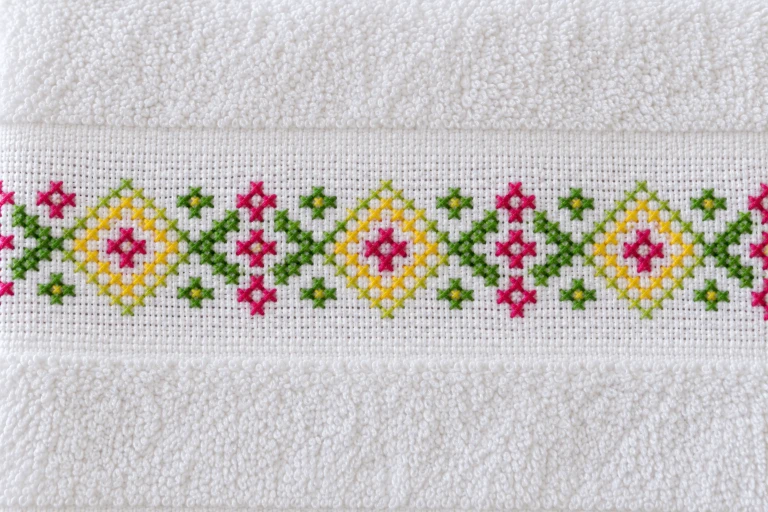
Count the clear Aida blocks between the woven transitions before placing the motifs.
Enlarge photoFind where the regular counted weave begins and ends. Exclude thick woven transitions, side hems, and any part that will disappear into a seam. Measure the fabric count in both directions, then follow the towel’s care instructions before taking final measurements if pretreatment is needed.
For example, DMC describes one stitchable towel with a 9 cm-wide 14-count Aida band. That identifies the product’s band and count; you should still check the actual open area of the towel in your hands.
We’ll reserve a 70-column by 26-row working window in a larger usable band. On 14 count it spans 12.70 × 4.72 cm. Center that window within the usable band. If your towel cannot provide it with the margin you want, change the layout before starting.
Place three motifs with equal gaps
Our three original geometric motifs each use a 12 × 12-cell chart box. Two gaps of eight blank columns make the group 12 + 8 + 12 + 8 + 12 = 52 columns wide. Inside the 70-column window, that leaves nine blank columns on each side.
Vertically, 26 − 12 = 14, so leave seven blank rows above and seven below. Numbering from 1 at the window’s upper-left cell, the motif boxes occupy:
| Motif | Columns | Rows |
|---|---|---|
| 1 | 10–21 | 8–19 |
| 2 | 30–41 | 8–19 |
| 3 | 50–61 | 8–19 |

The common center line lies between rows 13 and 14. The blank columns 22–29 and 42–49 form the two eight-column gaps; do not count a motif’s end cell as part of the gap.
Stitch the three motifs
Open the color-and-symbol layout or the color-only layout. These are two views of the same original working grid. Blank cells stay unstitched.


For a closer view of one motif:
| Motif | With symbols | Color only |
|---|---|---|
| 1 | Symbol chart | Color chart |
| 2 | Symbol chart | Color chart |
| 3 | Symbol chart | Color chart |


| Symbol | DMC cotton | Role |
|---|---|---|
| A | 3846 | Turquoise geometry |
| B | 742 | Gold accents |
Use the towel pattern’s strand guidance where supplied. Two individual strands of ordinary cotton are a useful starting point for this chart on 14-count Aida; the needle should pass comfortably through shared holes.
A removable thread along the window’s center can help you place the first motif. Count the eight blank columns before each next motif, keeping the reference thread clear of your stitches.
Keep the towel free while stitching
Arrange the towel so its weight is supported and the terry cloth is not pulled tightly across the counted band. If using a holder, position it on suitable flat fabric and keep thick seams or terry loops out of the clamped area.
Secure thread ends so they will remain contained during the towel’s intended use. Avoid long loose carries across the eight-column gaps, where they can show or catch. Finish one separated group and restart near the next when needed. Inspect the reverse for caught loops before they become buried beneath later stitches.
Remove temporary references when the group is complete and follow the towel and thread makers’ compatible care instructions.
When the window changes
If your usable window is 76 columns wide, the same 52-column group leaves 12 blank columns on each side. The motif origins move to columns 13, 33, and 53. The motifs and gaps keep their original cell counts.
If the usable band has fewer than 12 rows, choose smaller motifs.