
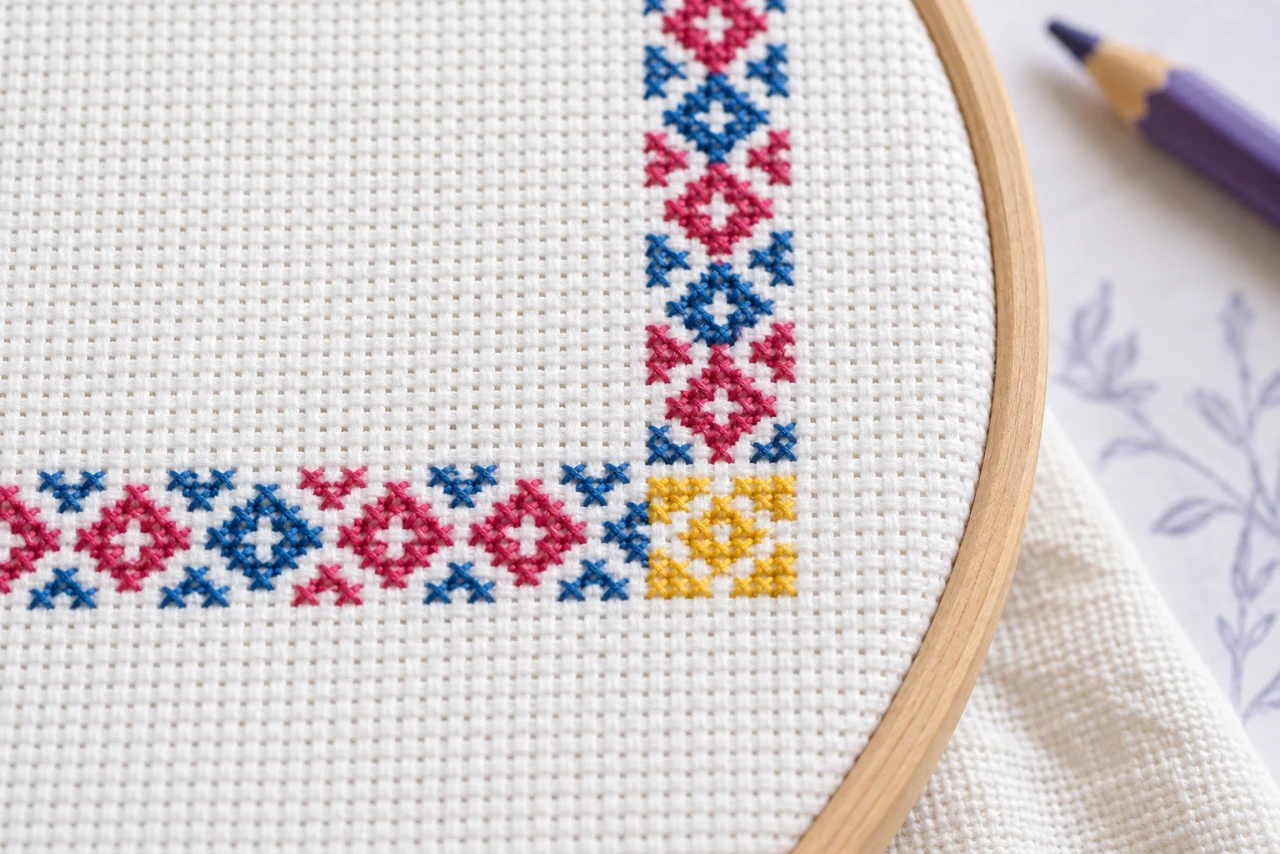
We'll build a small teal-and-pink border on a 30×22-cell chart. It has four solid corner blocks and a row of little cross-shaped flowers along each side. You can use the same calculation with your own leaves, diamonds, or geometric marks.
Draw the outside border
Draw the outside rectangle in chart cells. Our rectangle is 30 cells wide and 22 cells high; the border is 3 cells deep. Each filled cell will become one full cross stitch. A blank cell inside a repeat still takes up space, even though you won't put thread there.
The middle opening is 24×16 cells: subtract the 3-cell border on both opposite edges. Leave a clear gap between the border and any lettering or picture you add. For example, a 2-cell gap all around the inside leaves a 20×12-cell box for the central design.
These are design dimensions. For the stitched size and the extra fabric needed for a finish, use fabric-size arithmetic after the complete layout is settled. On 14-count Aida, our outer 30×22 cells occupy about 2.14×1.57 inches before finishing allowances.
Make two small modules
Our corner is a 3×3 block: eight teal crosses surrounding one pink cross. Use all nine cells for the corner.
The straight repeat is 4 cells long and 3 cells deep. Its five crosses make a little plus shape, with a pink center and teal arms. The fourth column is blank. That blank column belongs to the repeat and separates it from the next flower.
| Repeat row | Cells from left to right |
|---|---|
| Top | blank, teal, blank, blank |
| Middle | teal, pink, teal, blank |
| Bottom | blank, teal, blank, blank |
For the upright sides, turn that 4×3 unit through a quarter turn so it occupies 3 columns and 4 rows. The motif is symmetrical, so the flower keeps its shape; its spacer becomes a blank row. We'll place the spacer after the flower as we work down each side. This makes the left and right sides match. The top and bottom match each other too.
Fit the straight spans
Subtract both corner widths before dividing by the repeat length. Count each cell once; a corner's last column cannot also be the first column of a straight repeat.
| Side | Calculation |
|---|---|
| Top and bottom | Whole side: 30 cells. Corners reserved: 3 + 3. Straight span: 30 − 3 − 3 = 24 cells. Repeats: 24 ÷ 4 = 6. |
| Left and right | Whole side: 22 cells. Corners reserved: 3 + 3. Straight span: 22 − 3 − 3 = 16 cells. Repeats: 16 ÷ 4 = 4. |
There are 20 straight repeats altogether: six on top, six below, and four on each upright side. We can draw the entire outline now, before starting to stitch.

Open the symbol chart · Open the color-only chart · Download the stitch grid

Place the corners and repeats
The chart numbers columns from 1 to 30 and rows from 1 to 22. The left corners occupy columns 1–3; the right corners occupy columns 28–30. Use rows 1–3 for the top pair and rows 20–22 for the bottom pair.
The six top repeats start at columns 4, 8, 12, 16, 20, and 24 in rows 1–3. Their last blank column is 27, just before the right corner. Copy those same repeat positions into rows 20–22 for the bottom.
The four left repeats start at rows 4, 8, 12, and 16 in columns 1–3. Each flower occupies its first three rows, followed by one blank row. Copy those positions into columns 28–30 for the right side. Row 19 is the final spacer before the bottom corner starts at row 20.
Notice the join: a blank spacer before a corner is intentional in this design. It does not mean a flower is missing. Draw your own corner-to-repeat join at full size before filling a long side; a vine or directional leaf may need a different end module on each side.
Stitch the border
For this small border, 14-count Aida and two strands of ordinary six-strand cotton give you a straightforward starting setup. Use the same top-leg direction throughout, including the upright flowers. Rotating a chart motif changes its cell positions; it doesn't require you to reverse the top legs of its crosses.
Start with one corner and work along its neighboring side, counting the full 4-cell repeat between flower centers, including the blank column. End the thread before moving across the open center, where a carry could show.
The chart uses these two thread colors:
| Symbol | DMC cotton | Crosses |
|---|---|---|
| X | 3812 — Very Dark Seagreen | 112 |
| O | 3689 — Light Mauve | 24 |
The border contains 136 crosses.
When a side doesn't divide evenly
Suppose your picture needs an outer width of 31 cells. Keeping our two 3-cell corners leaves 25 cells. Six 4-cell repeats use 24 of those cells, leaving one extra cell to place deliberately.
You could put that spare blank column between the last flower and the corner on both horizontal sides. The border would have a slightly wider gap on the same end of each side. If you want equal gaps at both ends, a 32-cell outer width leaves 26 cells: six repeats plus one extra blank column at each end. Check whether the wider box still suits your central picture and finish.
Another option is to redraw a repeat with a different spacing rule. Work through the whole side on paper before stitching it. Changing only the final flower tends to make the join look accidental.
Calculate the height separately so the upright repeats fit between their corners too. Reserve its top and bottom corners, divide the remaining height by the upright repeat length, and decide where to put any leftover rows.