
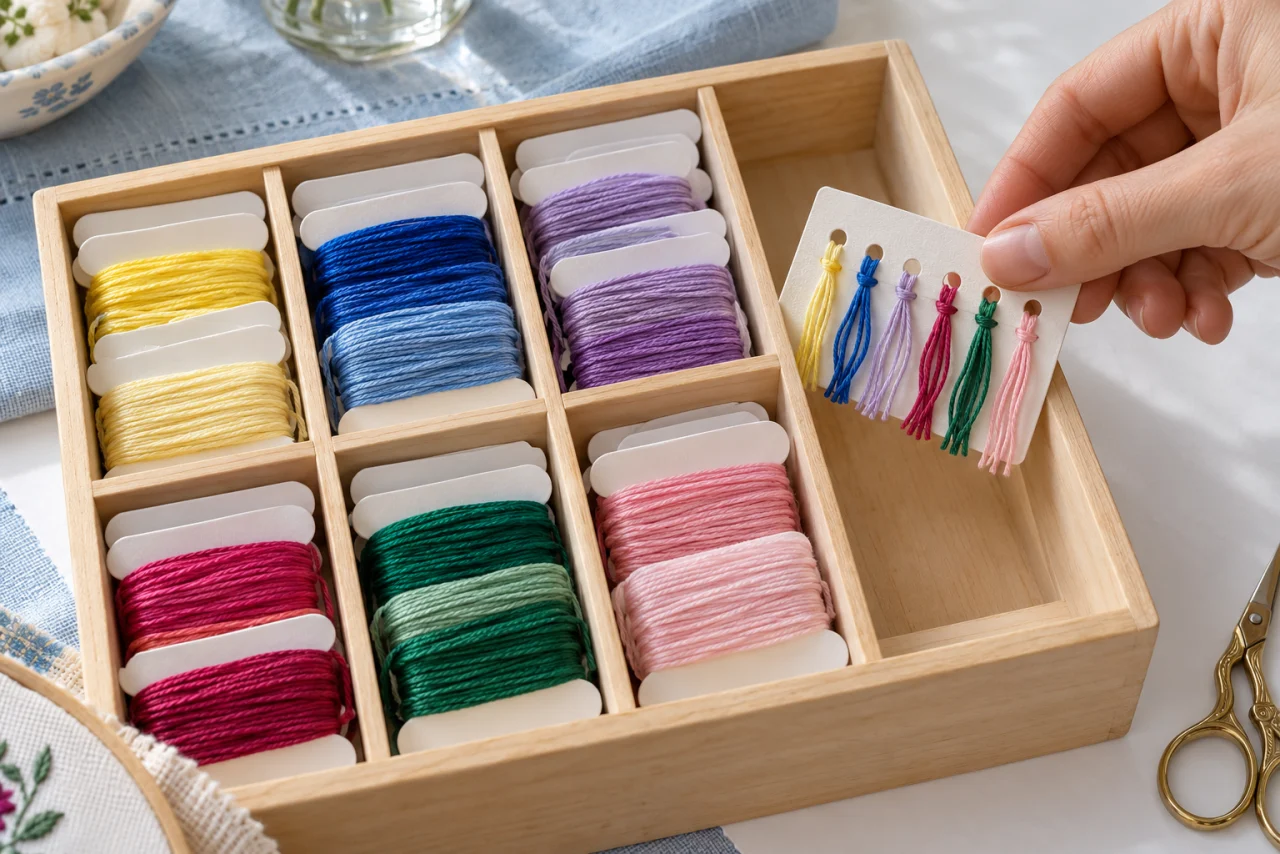
Label and store each color separately
Start with the pattern's thread key and the labels already attached to your skeins or kit card. Choose one place for each color: a bobbin, a floss drop, an individual bag, or a clearly labeled part of the supplied organizer.
Do not empty every skein onto a table before preparing the labels. Move one color at a time. Read its label, write the thread reference on its new holder, attach the thread, then check the pair before picking up another color.
Include the brand and range, as well as the shade number. The same number can identify different colors in different brands. For example, write “DMC, Article 117, 550.”
For kit thread without a manufacturer reference, keep the kit's own position or identifier. Do not invent a brand assignment from the color. Use the kit's identifier to match the supplied thread to its instructions.
Keep the chart symbol separate
A chart symbol tells you where that color is used in one design. It may mean something different in another pattern. A single skein can therefore carry a permanent shade label and a temporary project label.
Our example card keeps each identifier in its own field:
| Field | Example entry |
|---|---|
| Project | Little Border |
| Brand and range | DMC, Article 117 |
| Shade reference | 550 |
| Chart symbol | A |
| Kit position | 07 |
| Working strands | 2 |
If the kit's hole 7 means a different manufacturer number, record that actual mapping instead.
Catkin and Lillie's floss-drop tutorial shows a maker's system for storing full and working lengths. You can use the same labeling approach with holders you already own.
Reusing thread across projects
If two projects share a color, give each a labeled working portion and keep the main skein’s identity intact, including useful batch information.
Don't combine similar-looking leftovers from different sources; a close appearance can hide a different thread or shade.
Save usable leftover lengths
After ending a thread, decide whether the remaining piece is long enough for a useful task. Return usable lengths to the same labeled holder rather than mixing them with other colors.
Separate partial working lengths from unopened skeins so you can find them without unwinding everything. You can tie them loosely through a separate hole, keep them in a smaller labeled pocket, or loop them on a separate part of a drop. Avoid tight knots that make the next use difficult.
Keep separated working strands apart from full floss lengths, so you can tell what you are threading next time.
Some short pieces are not worth saving. Discard damaged or unusably short scraps, and keep usable thread labeled so you can find it again.
An optional thread list
Our project-thread worksheet has fields for the material, project identifier, and partial lengths. It can be opened in a spreadsheet or used as a model for a handwritten list. Start with the thread for your current pattern.
If a holder has lost its label, keep it apart and mark it unconfirmed rather than guessing. Our missing-label guide helps you decide what can be recovered.