
The stitch is also called double cross stitch. “Double” describes the two crossed shapes; it does not tell you how many floss strands to put in the needle. Chicken scratch on gingham uses double-cross foundations in a different, laced pattern.
Choose a four-thread footprint
Choose linen or evenweave and a tapestry needle that moves easily through it. The example uses two strands of ordinary cotton on 28-count cloth, with each Smyrna worked across four fabric threads in each direction. The midpoint of every side is two threads from its corners.
That creates a footprint twice the width and height of an ordinary over-two cross on the same ground. On Aida, the equivalent arrangement can span two blocks each way, with the upright cross using the side-midpoint holes. Do not place this whole diagram into a single Aida block and then try to force its midpoints through cloth threads.
For two-strand cotton, you can use a folded loop start.
Build four stitches in order
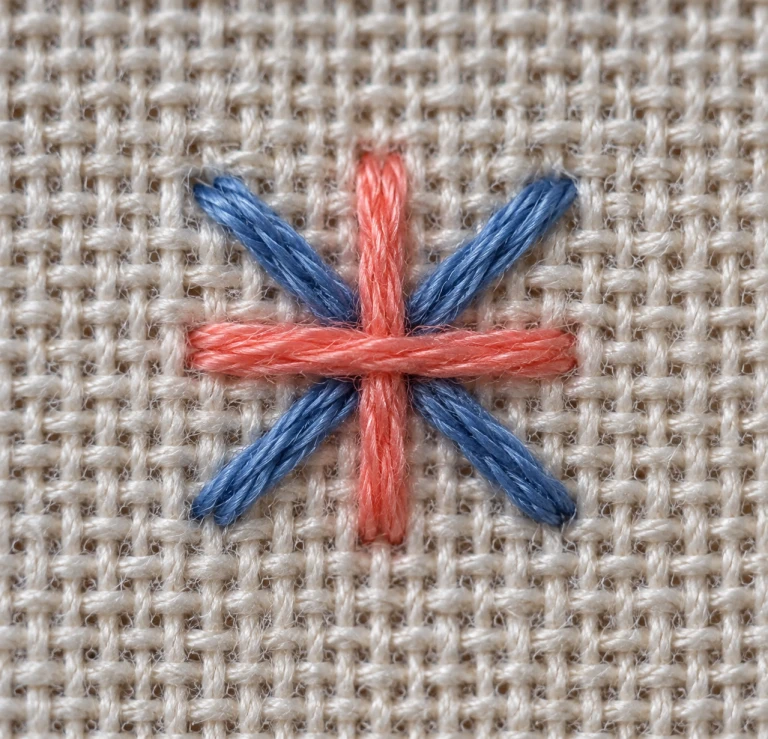
Work the diagonal cross first, then the vertical stitch and finally the horizontal stitch.
Enlarge photo
- Come up at 1, the bottom-left corner, and go down at 2, the top-right corner.
- Come up at 3, the bottom-right corner, and go down at 4, the top-left corner. You now have an ordinary X.
- Come up at 5, the bottom midpoint, and go down at 6, the top midpoint. This lays a vertical stitch across the X.
- Come up at 7, the left midpoint, and go down at 8, the right midpoint. This horizontal stitch sits above all the others.
Each new face stitch begins with a separate up movement. The connecting thread travels on the reverse. Do not connect 2 to 3, for example, with an extra visible line on the face.
The Royal School of Needlework’s double-cross lesson shows this diagonal-then-upright order. Keep the same final horizontal direction in every accent rather than alternating which layer finishes last.
Continue along a border
Three adjacent Smyrna crosses span twelve fabric threads when each uses a four-thread footprint. The footprints can share an edge without an extra gap.
Finish the first at its right midpoint, then bring the needle up at the bottom-left corner of the next footprint. Complete all four stitches there before moving to the third. Keep each set inside its own four-thread footprint.
Keep the horizontal stitch uppermost as you repeat, and secure the tail beneath suitable backs at the end of the row.
If you prefer separate stars, leave a counted space between footprints and account for the resulting reverse carry. On an open ground, a dark carry may be visible through the gap; end and restart rather than placing a long visible strand behind it.
Fix a missing or misplaced stitch
An accent resembling an ordinary X with a line through it may be missing one upright leg. Trace the eight endpoints rather than adding an uncertain extra stitch across its center.
If the middle becomes a tight lump, inspect the pull. Four stitches cross the same small center, so pulling each one harder can compress the thread and open the surrounding holes. Ease the last stitch or remake the trial with a better-fitting thread thickness.
If the upright cross leans, check whether you used a corner hole where you needed a midpoint. Count two fabric threads from each corner of this four-thread footprint; the midpoint is not estimated by eye.
For a two-color accent, finish and secure the diagonal layer before changing thread for the upright layer. The shape and order stay the same. Plan the color changes before stitching the row to avoid a separate knot or carry behind every center.